How to check an appliance for recalls in 4 steps
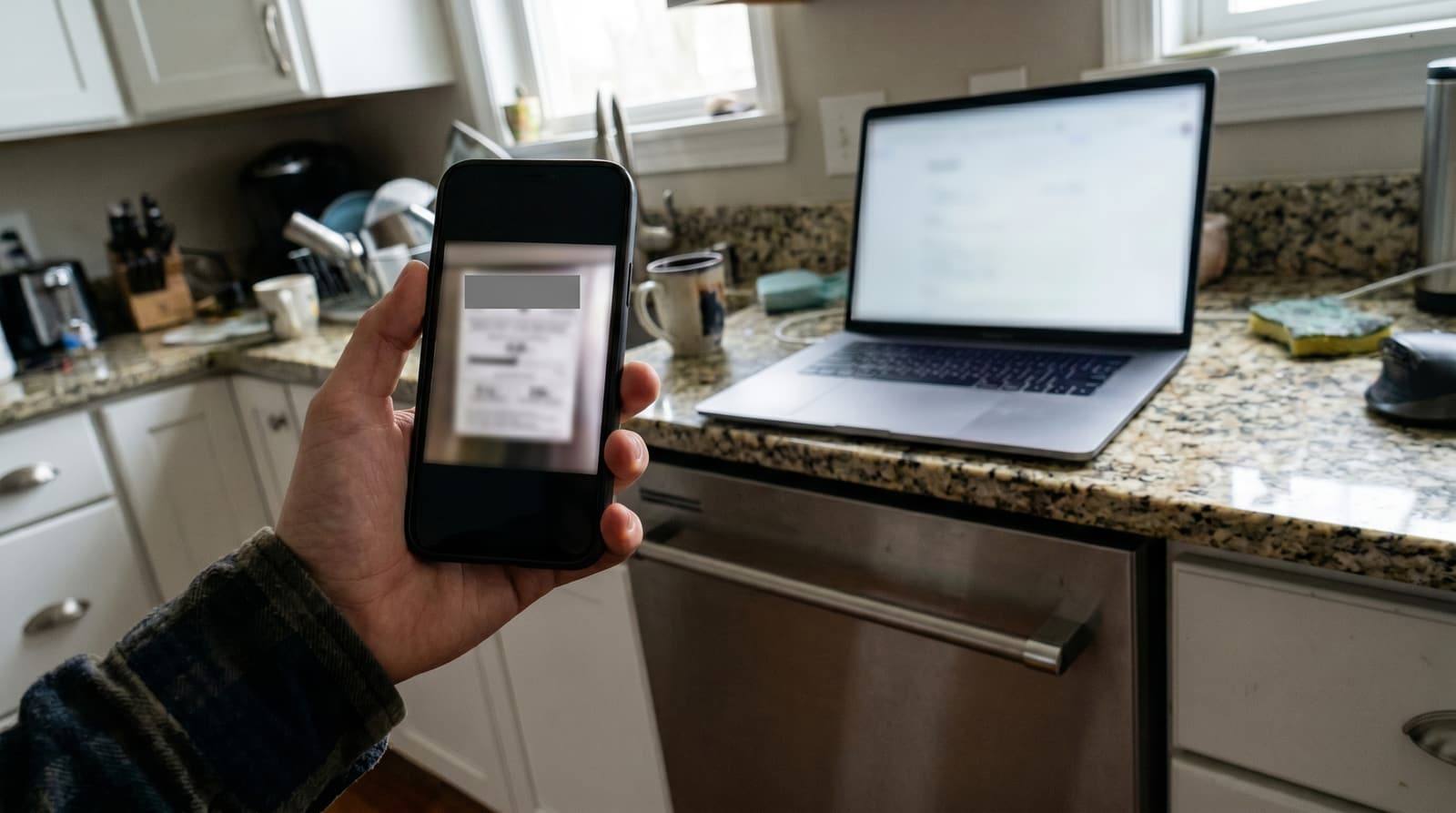
- Find the model and serial number. They’re on a label, often inside the fridge, on the washer’s lid, inside the dryer door, on the dishwasher’s door edge or inside the oven door or storage drawer. On a water heater, it’s on the rating plate, usually on the side of the heater. Photograph it.
- Search the model number. Use the checker above, then search the same model at cpsc.gov/Recalls. CPSC’s reseller guide also tells sellers to check SaferProducts.gov, where CPSC takes reports of unsafe products.
- Check the brand’s own recall page (table below). Manufacturers list their current recalls there, with lookup tools for affected serial numbers.
- Read the official notice. Confirm your model and serial range are included, and note the remedy and the contact details.
Manufacturer recall pages
| Brand | Official recall page | Notes | Basis |
|---|---|---|---|
| Whirlpool Corporation (Whirlpool, KitchenAid, JennAir, Amana, Maytag) | whirlpoolcorp.com/recall.html | Current recalls, quality campaigns and a Past Recalls page | official (manufacturer) |
| GE Appliances | GE Appliances recall information | GE’s recall hub; also search CPSC for “GE Appliances” | official (manufacturer) |
| LG | lg.com/us/public-notices | Recall notices are listed as public notices | official (manufacturer) |
| Frigidaire and Electrolux | Frigidaire recall information | Lists recalls, including the March 2026 gas range recall (burn hazard) | official (manufacturer) |
| Samsung | Recall-specific pages linked from each CPSC notice, e.g. range knob kit | We couldn’t verify a single Samsung US page listing all recalls. Start from CPSC | official (CPSC notices) |
What to do if a used appliance is recalled
If you own it:
- Follow the notice. Recent notices tell consumers to stop using the product, or to use it with a specific precaution, until the remedy is done.
- Contact the company listed. Remedies are usually a free repair, a replacement or a refund. For example, Samsung’s 2016 washer recall offered a free in-home repair, a rebate toward a new washer, or a refund for recent buyers, and its 2024 range recall provides free knob locks.
- Keep the confirmation that the repair was done.
If you’re buying:
- Ask the seller for proof the recall repair was completed. For a software fix, the notice itself may explain how to check. Samsung’s 2022 washer notice links instructions for checking whether a washer’s software was updated.
- If there’s no proof, don’t buy it. It is unlawful to sell a recalled product that hasn’t been repaired under the recall.
If you’re selling:
- CPSC says it is illegal to sell any recalled product, and that when reselling a product it’s your responsibility to know whether it has been recalled. The rule is Section 19 of the Consumer Product Safety Act (15 U.S.C. § 2068).
- CPSC’s February 2025 Resellers Guide lists recalled products as not sellable “unless the products have been repaired in accordance with the recall.”
- CPSC’s laws apply to thrift stores, consignment stores, charities and individuals at yard sales and flea markets. CPSC also says its staff monitor online marketplaces for recalled products.
Notable major-appliance recalls (examples)
These show what appliance recalls look like. They’re not a complete list. CPSC’s Resellers Guide says it is aware of over 400 recalls involving home appliances.
| Recall date | Product | Hazard | Units | Remedy | Official notice |
|---|---|---|---|---|---|
| Nov 4, 2016 | Samsung top-load washers | Top can detach during use (impact injury) | About 2.8 million | Free repair, rebate toward a new washer, or refund (recent buyers) | CPSC notice |
| Apr 14, 2022 | GE bottom-freezer French-door refrigerators | Freezer handle can detach (fall hazard) | About 155,000 | Free in-home service | CPSC notice |
| Dec 22, 2022 | Samsung top-load washers (WA49B–WA55A series) | Short-circuit and overheating (fire) | About 663,500 | Software repair | CPSC notice |
| Feb 8, 2024 | Frigidaire side-by-side refrigerators with slim ice buckets | Broken plastic pieces in ice (choking, laceration) | About 383,240 | Repair | CPSC notice |
| Aug 8, 2024 | Samsung slide-in electric ranges | Front knobs can be turned on by accidental contact (fire) | About 1,120,905 | Free knob locks or covers | CPSC notice |
| Feb 6, 2025 | LG slide-in and freestanding electric ranges | Front knobs can be turned on by accidental contact (fire) | About 500,000 | Warning label and Control Lock instructions | CPSC notice |
All figures are from the CPSC notices linked (basis: official). For the Samsung range recall, CPSC reports about 250 fires and 40 injuries tied to unintentional knob activation. For the LG ranges, it reports more than 28 fires.
How our recall checker works, and what it can miss
The checker above uses data from CPSC’s public Recalls API. In CPSC’s data, the structured model-number field is usually empty. Model numbers mostly appear in the free-text description of each notice. So our checker extracts model numbers from that text and matches the one you enter.
That approach has blind spots:
- Serial ranges. Many notices cover a model only within certain serial numbers. A model match means “read the notice”, not “recalled”.
- Missing or partial model lists. Some notices describe products by brand, type or date instead of listing every model. Some point to the manufacturer’s website for the full list. The checker won’t match those.
- Text formatting. Model numbers with wildcards, suffixes or unusual spacing may not match exactly. Try with and without the suffix (for example “/AA” or “/US”).
- Timing. New recalls appear once our copy of the data refreshes.
- Non-CPSC campaigns. Manufacturer service campaigns that aren’t CPSC recalls won’t appear.
A “no match” result is not a safety clearance. Always confirm on cpsc.gov/Recalls and the brand’s page. When the checker does find a match, it links the official notice. The notice, not our summary, is what counts.
What more than 50 years of CPSC appliance recalls show
We counted every household appliance and water heater recall in our CPSC recall index: 235 recalls announced from June 1973 to September 2026, covering at least 45.3 million units sold in the US. Five findings stand out.
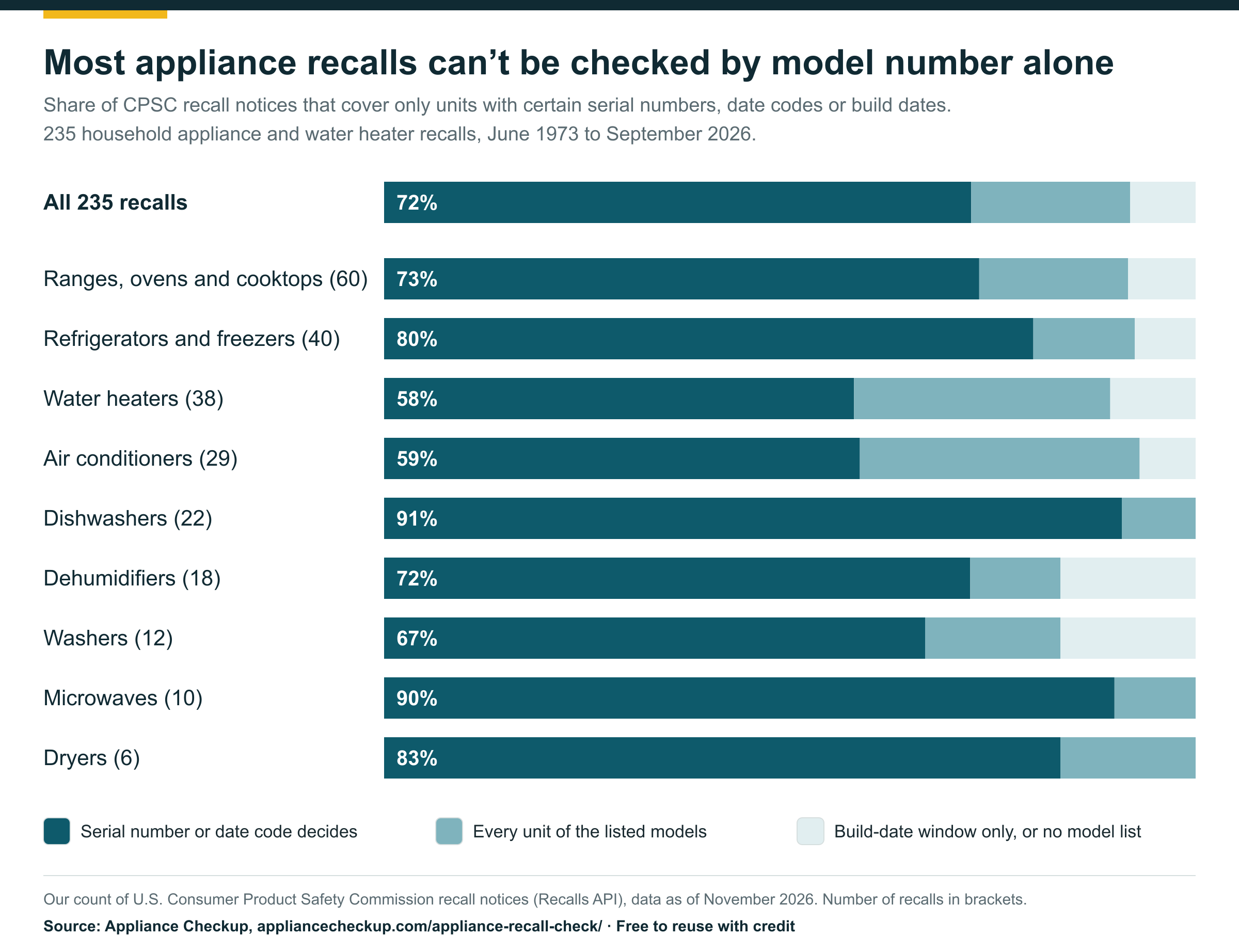
- Most recalls can’t be checked by model number alone. In 170 of the 235 recalls (72%), only units with certain serial numbers, date codes or build dates are recalled, so the same model made a few weeks earlier or later may not be. The share is the same for recent recalls: 49 of the 68 announced since 2016 (72%). Only 46 recalls (20%) cover every unit of the models they list. For example, A.O. Smith’s 2018 recall of about 616,000 Ultra-Low NOx gas water heaters covers only units whose serial number starts with 1115 to 1631, digits that give the year and week they were made.
- Fire is the hazard in almost three recalls in four. 171 recalls (73%) cite fire, burns or overheating, including all 22 dishwasher recalls. Water heaters add other risks: 11 of their 38 recalls cite carbon monoxide and 9 a gas leak or explosion. In 14 of the 40 refrigerator and freezer recalls the risk is an injury, such as a door or handle coming off, ice-maker parts breaking into the ice, or a child trapped in an old freezer.
- Dishwashers and dehumidifiers account for over half the units. Ranges, ovens and cooktops have the most recalls (60), but dishwashers (about 12.6 million units in 22 recalls) and dehumidifiers (about 12.1 million in 18) make up 54% of all units counted. The three largest recalls were dehumidifiers made by Midea, about 3.4 million units (2016); GE and Hotpoint dishwashers, about 3.1 million (1999); and Samsung top-load washers, about 2.8 million (2016).
- Recalls come years after the sale, and most recalled units are now old. In the 191 notices that say when sales began, the median recall came 3 years after the first units were sold, and 39% came 5 or more years after. Of about 42.2 million units recalled since 2000, 26.2 million (62%) were in recalls announced at least 10 years ago. At least nine recalls were announced again, some because of more fires and a low response from owners: in 2013, Sears re-announced its recall of about 795,000 Kenmore dehumidifiers.
- Recalls keep coming at a steady pace. There were 80 recalls in the 2000s and 69 in the 2010s; the 2020s have had 46 so far (January 2020 to September 2026).
| Appliance | Recalls | US units recalled | Serial number or date code decides | Hazard cited most |
|---|---|---|---|---|
| Ranges, ovens and cooktops | 60 | 3.2 million | 44 (73%) | Fire or burns (47) |
| Refrigerators and freezers | 40 | 4.8 million | 32 (80%) | Fire or burns (18), injury (14) |
| Water heaters | 38 | 1.2 million | 22 (58%) | Fire or burns (22), carbon monoxide (11) |
| Air conditioners | 29 | 4.6 million | 17 (59%) | Fire or burns (26) |
| Dishwashers | 22 | 12.6 million | 20 (91%) | Fire or burns (22) |
| Dehumidifiers | 18 | 12.1 million | 13 (72%) | Fire or burns (17) |
| Washers | 12 | 4.7 million | 8 (67%) | Fire or burns (6), injury (6) |
| Microwaves | 10 | 2.0 million | 9 (90%) | Fire or burns (9) |
| Dryers | 6 | 48,000 | 5 (83%) | Fire or burns (4) |
| All | 235 | 45.3 million | 170 (72%) | Fire or burns (171) |
Basis: official (CPSC recall notices), our count. Units are the US figures in CPSC’s recall data, rounded, with each unit counted once. Notices with no figure there add nothing, so the unit totals are a minimum.

What it means for you. Check the model and the serial number against the notice, every time. A model match alone may not mean your unit is recalled, and an old recall still counts. The checker above matches model numbers only; for five water heater recalls defined by serial number or build date, the water heater age checker also tests the serial you enter against the notice. To read the build date from an appliance serial number, see how old is my refrigerator.
How we counted
- Data. CPSC’s full recall list, downloaded from its Recalls API on 2 November 2026. Our index held 240 recalls (the newest dated 17 September 2026). We left out 5: 3 commercial-only products (rooftop air conditioners, grocery-store freezers and food-service refrigerators) and 2 air conditioner recalls our filter had missed, which were added to the index after this analysis (Amana, Daikin and Goodman packaged units, 2024; Frigidaire and Carrier through-the-wall units made by Electrolux, 2004).
- Units. The US figure each notice gives, not units sold in Canada or Mexico. When a recall was announced again we didn’t count its units twice (the re-announcement still counts as a notice), and expansions count only the units they added. 41 notices, mostly from before 2000, have no unit figure in CPSC’s data (many of the older releases mention one in their text), so their units aren’t in the totals. The “up to 9 million” chest freezers made from 1945 to 1970, named in a 2000 campaign about old freezers, aren’t counted.
- Serial or date code. A recall counts when the notice limits it to serial number ranges, beginning or ending letters, date codes, batch numbers or build dates shown on the label. We flagged notices by their wording, then read every notice to correct the flags. Another 9 notices give only a build-date window, with no serial or date-code list; they aren’t counted, so the 72% is if anything low.
- Hazards. From CPSC’s hazard text, or the release itself for old notices. A recall can cite more than one hazard.
- Years after the sale. From the first sales date the notice gives to the recall date.
Basis: official (CPSC recall notices), our count and our classification. We didn’t test or inspect any product.
What this data can’t tell you
- Where the units are. CPSC notices give units sold across the US, with no state or city figures, so we can’t say how many recalled appliances are in a given state.
- How many were fixed. Notices don’t report how many owners responded. Remedies vary too: of the 109 notices where CPSC’s data lists the remedy type, 83 offer a repair, 21 a refund and 15 a replacement (some offer more than one).
- Whether your unit is safe. Counts of notices aren’t counts of incidents, and a “no match” in our checker is not a safety clearance.
Reuse this analysis. Download the per-recall counts as a CSV file and the chart as a PNG image. Both are free to reuse, in print or online, with credit to Appliance Checkup and to CPSC as the original source; a link to this page is welcome but not required (terms). Suggested credit: “Source: Appliance Checkup analysis of CPSC recall data.”
About this data, and reusing it
Our recall index comes from the U.S. Consumer Product Safety Commission’s Recalls API on SaferProducts.gov. We download CPSC’s full recall list every day and keep the recalls for household appliances: ranges, ovens and cooktops; refrigerators and freezers; water heaters; air conditioners; dishwashers; dehumidifiers; washers; microwaves; and dryers. On 2 November 2026 it held 240 recalls, dated June 1973 to September 2026. The checker above shows the date the index last changed. The analysis above is a snapshot from 2 November 2026.
For each recall we keep the CPSC recall number, date, title, appliance type, brand names, short hazard and remedy summaries, the link to the official notice and the model numbers we found in the notice text. Model numbers are extracted automatically, so a list can be incomplete; the official notice is what counts.
Download the index as a CSV file (opens in a spreadsheet) or as JSON. It’s free to reuse with credit to Appliance Checkup and to CPSC as the original source; a link is welcome but not required (terms).
Limitations
This page covers US recalls announced with CPSC. It doesn’t cover recalls in other countries or problems that were never recalled. Report a hazard you’ve found at SaferProducts.gov.
What to do next
- Buying used? Work through the used appliance buying checklist.
- Selling? See where to sell used appliances and set a price with how much is my used appliance worth.
- Recalled and not worth fixing? Try the repair or replace calculator.
Checked against the sources below on 26 September 2026.