Find the rating plate
Every central air conditioner, heat pump and furnace has a rating plate: a label with the model number, the serial number and the electrical or gas ratings. It’s where any HVAC serial number lookup starts, and the quickest route to answering “how old is my AC unit?” or “how old is my furnace?”
| Equipment | Where the maker says to look |
|---|---|
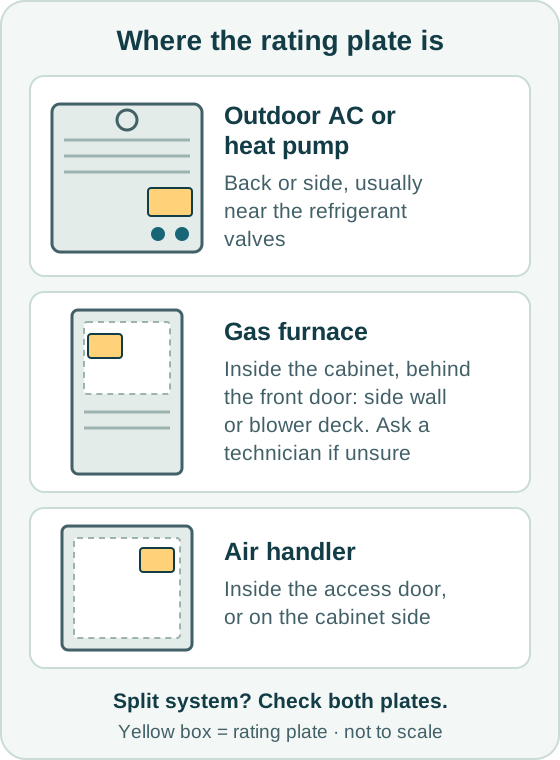
| Outdoor condenser (central AC) or heat pump | On the back of the unit near the refrigerant service valves (Carrier; Goodman says “slightly above the refrigerant valves”). Lennox says near the service panel |
| Gas furnace | Inside the cabinet, behind the front door panel (Carrier). Lennox: behind the top-front service panel, on the left side of the cabinet or the top of the blower deck, depending on the model |
| Air handler | Inside the front door panel (Carrier) |
| Packaged unit (all-in-one, outdoors) | One plate for the whole unit: on one end (Trane, CPSC 2005), on the back (Trane, CPSC 2025) or on the control compartment door at the front (Goodman, CPSC 2008) |
Basis: official (Carrier, Lennox and Goodman homeowner FAQs; Rheem’s model and serial page; CPSC recall notices 05-104, 08-555 and 25-369).
The outdoor plate is on the outside of the cabinet; don’t open the electrical access panel to look for it. If you’d rather not open a furnace or air handler, the installer’s paperwork may carry the details. Goodman says many dealers attach the shipping box’s “traveler label” to the homeowner’s paperwork. A licensed HVAC technician can read the plate during a service visit.
Photograph the whole plate. The serial number gives the date; the model number identifies the unit for parts, warranty and recall checks.
A split system has two plates
Rheem puts it simply: two model and serial tags identify split-system equipment, and one tag identifies packaged equipment. The outdoor unit (condenser or heat pump) and the indoor unit (furnace or air handler) each have their own plate. They can show different dates, because either part may have been replaced on its own. Check both: if you’re asking how old your heat pump or AC unit is, read the outdoor plate; for the furnace or air handler, read the indoor one. (The different-dates point is our reading, not a Rheem statement.)
A printed date beats any decode
Some plates print the manufacture date outright. CPSC’s 2005 notice on Trane and American Standard packaged units describes plates showing the year, month and day of manufacture. If your plate shows a date, use it and skip the serial code.
HVAC serial number lookup by brand
Reading AC unit age by serial number depends on the brand. The checker above reads the brands marked “decoded now”. For the others we haven’t yet finished the source checks we need before a decoder goes live.
| Brand | Status | What the date code looks like |
|---|---|---|
| Goodman, Amana HVAC, Daikin (US ducted central systems) | Decoded now | First four digits = year and month (YYMM). Goodman’s example: 1306… = June 2013. See Goodman serial number age |
| Carrier, Bryant | Decoded now | First two digits = week, next two = year, then a plant letter. Carrier’s manual example: 01 18 E 00001 = week 1 of 2018. See Carrier serial number age |
| Payne | Not decoded | Payne is now WeatherMaker by Carrier, but we haven’t found a Carrier or Payne document that explains Payne serials |
| Trane, American Standard | Decoded now | Since 2010: first two digits = year, next two = fiscal week, then a day digit. From 2002 to 2009 the serial starts with one year digit (Trane’s ten-digit layout, used since 2004, leaves the first position blank until 2010), and before that with a year letter. Example from a CPSC recall: 24061381FA = week 6 of 2024. See Trane serial number age |
| Lennox | Coming soon | Details when the decoder is ready |
| York | Not decoded | We haven’t found a manufacturer document that explains the code, and the published secondary charts we checked don’t agree |
| Rheem | Not decoded | Same problem: no manufacturer explanation found for HVAC units, and secondary references disagree on whether the week or the year comes first |
| Ductless mini-splits (all brands) | Not decoded | We haven’t found manufacturer documentation for reading a date from these serials. Use the date printed on the plate or ask the maker |
Basis: official (Goodman and Daikin warranties; CPSC 05-104 and 25-369, which name Trane and American Standard together; Carrier 24VNA6/25VNA4 service manual; Bryant service manual; Payne’s website; Trane product handbook 22-8301-39). The “not decoded” rows are our assessment of the sources we found as of 14 October 2026.
For any brand, the maker’s support line or a licensed HVAC technician can confirm the date from the model and serial number.
How long AC units, heat pumps and furnaces last
HVAC age matters most when you compare it with a typical lifespan. Published figures vary; here is what three US sources say:
| Equipment | InterNACHI estimate | NAHB study (2007) | ENERGY STAR: consider replacing when older than |
|---|---|---|---|
| Central air conditioner | 7–15 years (condenser 8–20) | 10–15 years | 10 years |
| Heat pump | 10–15 years | 16 years | 10 years |
| Furnace | 15–25 years | 15–20 years | 15 years |
Basis: trade estimate (InterNACHI’s Standard Estimated Life Expectancy Chart, which InterNACHI says should be used “as guidelines only”); industry study (NAHB/Bank of America Home Equity Study of Life Expectancy of Home Components, February 2007); official (ENERGY STAR’s “When is it time to replace?” page). The NAHB figures are averages from a 2007 study.
The checker above compares your unit’s age with typical lifespans like these.
What the age means for repair or replace
The age is a planning number, not a verdict on one unit.
- Under about 10 years (AC or heat pump) or 15 years (furnace): younger than the ages at which ENERGY STAR suggests considering a replacement.
- Past those ages: ENERGY STAR lists age as one sign to consider replacing. Its other signs include frequent repairs with rising energy bills, rooms that are too hot or too cold, humidity problems, excess dust and a noisy system.
- Near or past the top of the published ranges: older than most of the figures above. It’s sensible to budget for a replacement even if the unit still runs (our suggestion, not a source’s).
Don’t attempt gas, refrigerant or electrical work yourself. For a diagnosis, a repair quote or a replacement estimate, hire a licensed HVAC technician. Buying a house? Record each unit’s age in your inspection notes. Our home systems age report and tools for home inspectors put appliances, water heaters and HVAC units (Goodman family, Carrier, Bryant, Trane and American Standard decoded) on one printable page. For the water heater, see how old is my water heater?
Recalls
CPSC does recall furnaces and packaged heating and cooling units, and its notices often define the recalled units by a serial number range that encodes the build date. Three examples:
- Trane and American Standard, 05-104 (2005): packaged units with serial numbers beginning 3383 through 4475. CPSC explains that the first four digits give the year, fiscal week and day of manufacture.
- Goodman, 08-555 (2008): package gas-electric units with serial numbers beginning 0712, 0801 and 0802, sold December 2007 through February 2008.
- Trane and American Standard, 25-369 (2025): five packaged-unit models with listed serial ranges, sold January 2024 through March 2025.
Basis: official (CPSC notices in the sources). Search CPSC’s furnace recalls and the full CPSC recall list with your brand and model number, and confirm the exact models and serial ranges on the notice.
Our recall check covers appliances and water heaters only. It doesn’t check HVAC equipment yet.
Limitations
- The serial gives the build date, not the installation date. A unit can sit in a warehouse before it’s installed. Goodman’s warranty, for example, assumes installation three months after the manufacture date when the real date can’t be verified.
- Some brands’ codes (Carrier’s and Trane’s, for example) give a week of the year, not a month.
- The serial can’t tell you the unit’s condition, or maintenance history. Ask a licensed HVAC technician about those.
Checked against the sources below on 14 October 2026.