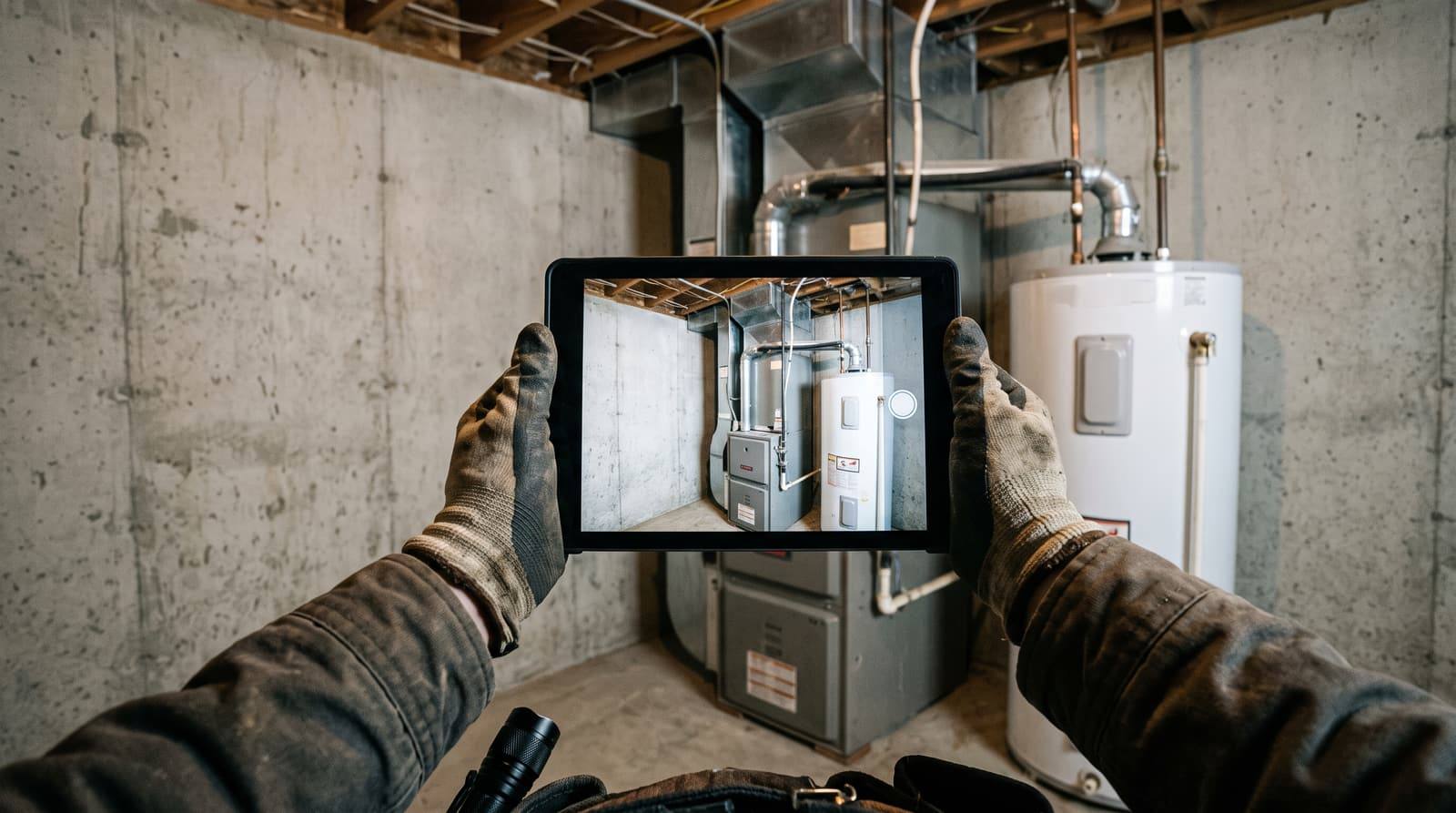
Start here: a one-page age report for your client
List up to 8 appliances, water heaters and HVAC units from their rating plates, and print one US Letter page with each build date, the age against published lifespans and, for appliances and water heaters, a CPSC recall check by model number. It’s free, with no sign-up, and you can hand it to your client unchanged. Your entries are saved in this browser on this device, so you can fill it in during the walkthrough and print it later from the same device (private browsing clears them when all private tabs and windows are closed).
Make a report → · See a sample report
The sample loads three documented serials (a Bradford White water heater, a Whirlpool washer and a Samsung dryer) so you can see the finished page before entering your own. If you already have saved entries, the report keeps them instead; “Try an example” on the report replaces them.
Who the site is for
Appliance Checkup is a free reference site for US homeowners, buyers and sellers of used appliances, home inspectors and real estate agents. It answers four questions from the rating plate: how old is this unit, how does that compare with typical lifespans, is the model on a US CPSC recall notice, and (for appliances) what is it worth used. We don’t inspect, sell, repair or rate products, and pages are written by the Appliance Checkup editorial team.
Free tools
| Tool | What it does |
|---|---|
| Appliance and water heater age checker | Brand + serial number → manufacture date, age against typical lifespan, and a recall check when you add the model number. Covers refrigerators, washers, dryers, dishwashers, ranges and water heaters. |
| Home systems age report | Up to 8 appliances, water heaters and HVAC units on one printable US Letter page: build date and confidence, age, typical life, stage and recall result per item, with blank lines for the address, date and your name. |
| AC and furnace age | Brand + serial number → build date and age against typical lifespan for central ACs, heat pumps and furnaces. Decodes Goodman, Amana, Daikin, Carrier, Bryant, Trane and American Standard so far. |
| Recall check | Model number → US CPSC appliance recall notices that list it, with a link to each official notice. |
| Repair-or-replace calculator | Compares a repair quote with Consumer Reports’ 50 percent rule of thumb and shows the unit’s age against its typical lifespan. Includes tank water heaters. |
| Water heater replacement cost estimator | Installed price by heater type (the middle of three national cost guides), with an optional state adjustment that is our estimate. |
Basis: each tool’s page lists its own sources and labels its estimates. For water heaters, the water heater hub has the date code for each brand we decode.
Printables
| Printable | What’s on it |
|---|---|
| Appliance age cheat sheet (PDF, 1 page) | Six diagrams showing where the label is on refrigerators, washers, dryers, dishwashers and ranges, the date rule for 8 brand families with a highlighted example, typical lifespans and where to check recalls. A 2-page large-print edition is easier to read on screen. |
| Water heater age cheat sheet (PDF, 1 page) | Where the rating plate is, date codes for Bradford White, the A.O. Smith and Rheem groups, Lochinvar, Navien and Rinnai, lifespans by heater type, and the recall steps. |
| Home systems age report | Generated from what you enter, then printed or saved as a PDF from your browser. |
All of them may be printed and handed to clients unchanged. Each carries its basis and the line “not an inspection, warranty or appraisal” in the footer; please leave that in place.
What inspection standards say about age
Two national US standards of practice leave age out of the required scope: InterNACHI’s says the inspector is not required to measure a water heater’s age or life expectancy, and ASHI’s says the inspector is not required to determine the remaining life expectancy of systems and components.
| Standard | What it says | Section |
|---|---|---|
| InterNACHI | The inspector is not required to “measure the capacity, temperature, age, life expectancy or adequacy of the water heater” | 3.6 Plumbing |
| InterNACHI | The inspector is not required to “inspect or move any household appliances” or “inspect appliances” | 3.10 Doors, Windows and Interior |
| InterNACHI | “The fact that a system or component is near, at, or beyond the end of its normal, useful life is not, in itself, a material defect.” | 1.2 Definitions |
| ASHI (2014) | The inspector shall inspect “installed ovens, ranges, surface cooking appliances, microwave ovens, dishwashing machines, and food waste grinders by using normal operating controls to activate the primary function” | 10.1.F |
| ASHI (2014) | The inspector is not required to inspect other “installed and free-standing kitchen and laundry appliances” | 10.2.G |
| ASHI (2014) | The inspector is NOT required to determine “the remaining life expectancy of systems and components” | 13.2.A |
Basis: industry standards (InterNACHI, last revised October 2022; ASHI, effective March 1, 2014), quoted as published on 30 September 2026. ASHI’s members approved a new standard in a vote that closed on January 8, 2026; ASHI says the 2014 standard stays current until the new standard’s implementation date. Some states set their own standard for licensed inspectors.
So an age is extra information, not a required finding. If you choose to note one, the age report shows where each date and lifespan comes from, and the water heater inspection guide sets out what InterNACHI and ASHI require for water heaters.
How our facts are checked
- Every figure has a named source in the page’s source list; tables and estimates carry a basis label, such as official, industry study, trade estimate, retailer or dealer listings, or our estimate. Our estimates always say so.
- Date codes are tested against serial numbers documented by manufacturers, CPSC recall notices or independent references. A decoder change doesn’t ship unless every test passes.
- Before publishing, a separate AI fact-check pass that didn’t write the draft checks new and changed figures against their named sources, and the editorial team approves each release before it goes live. We log the fixes.
- Recall data comes from the US Consumer Product Safety Commission and is refreshed daily. We always link the official notice.
The full method, and a dated log of every correction, is on how we check facts.
How to cite or link us
You’re welcome to link any page or quote short passages; please credit Appliance Checkup. A link is welcome but not required. Suggested citation:
Appliance Checkup, <page heading>, appliancecheckup.com/<path>/, accessed <date>.
For example: Appliance Checkup, “How old is my water heater? Read the date from the serial number”, appliancecheckup.com/how-old-is-my-water-heater/, accessed September 30, 2026.
Our state cost table and recall index are free to reuse with credit. Please don’t copy whole pages; see our terms.
Corrections and feedback
If you find an error, or a serial format we get wrong, email hello@appliancecheckup.com or use the contact page. A photo of the rating plate with the printed date helps us check a decoder. Feedback on the age report and the cheat sheets is welcome too.
Limitations
- We haven’t inspected any appliance or water heater. The tools summarize published data and manufacturer date codes; they are not an inspection, a warranty or an appraisal.
- The decoders cover the brands listed on each tool. For other brands, a date printed on the rating plate is the only reliable source.
- The recall check reads model numbers from the text of CPSC notices and can miss some. A match must be confirmed on the official notice, and no match is not proof of safety.
- We quote the standards as published. Your state’s licensing rules and your pre-inspection agreement set the scope of your inspection.
Checked against the sources below on 1 October 2026.