Water heater lifespan by type
| Type | Typical life | Source |
|---|---|---|
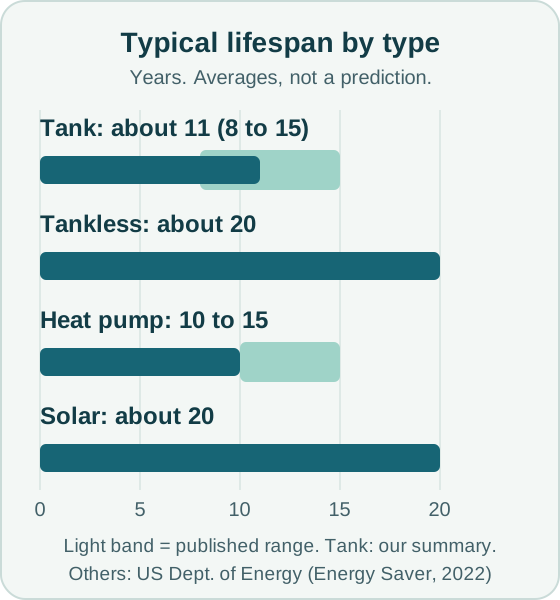
| Tank (storage), gas or electric | About 11 years (8 to 15) | Our summary of the figures below |
| Tankless (on-demand) | About 20 years | DOE; ENERGY STAR; Consumer Reports “at least 20”; NAHB 20+ (InterNACHI’s chart says 10) |
| Heat pump (hybrid) | 10 to 15 years | DOE; Rheem |
| Solar | About 20 years | DOE |
Basis: official (US Department of Energy; ENERGY STAR) and industry study (NAHB 2007; Consumer Reports; InterNACHI). DOE’s figures in this table come from its Energy Saver comparison chart (February 2022). DOE removed that page in 2026, so we link an archived copy. For tankless, DOE’s 2024 rule for gas tankless heaters also estimated an average life of around 20 years; Congress disapproved that rule and DOE withdrew it in May 2025, but the lifetime figure is DOE’s published estimate. ENERGY STAR says tankless heaters “have a life expectancy of 20 years.” Its savings figures for heat pump water heaters assume a 13-year life; that’s a calculation assumption, not a lifespan claim.
Tank water heaters: every figure we found
| Source | Tank water heater |
|---|---|
| US DOE, Energy Saver (2022; archived copy) | 10 to 15 years |
| US DOE 2024 water heater rule | About 15 years (average, storage) |
| NAHB/Bank of America study (2007) | Gas 10 years, electric 11 |
| InterNACHI life expectancy chart | 6 to 12 years (conventional) |
| A.O. Smith | 8 to 12 years |
| Rheem | 8 to 12 years; recommends “beginning replacement planning around year 10” |
| Bradford White | 8 to 12 years (Jul 2026 article); its FAQ says “10 years or more” with proper installation and maintenance |
| Angi (cost guide) | Electric 10 to 15 years, gas 6 to 12; about 11 on average |
Basis: official (DOE), industry study (NAHB, InterNACHI), manufacturers and a trade estimate (Angi), as listed in the sources. Our summary: about 11 years, with most figures between 8 and 15. Our water heater age checker compares your heater’s age with that figure.
Why the spread? In our reading, the sources answer different questions: the DOE rule needs an average lifetime for its energy-savings analysis, manufacturers give owners a planning range, and inspection charts are rules of thumb. None of them predicts how long one heater will last.
How old is yours?
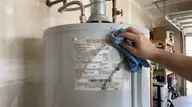
The date is in the serial number on the rating plate. Use our free water heater age checker, or read it by brand:
- Bradford White: year letter, then month letter
- A.O. Smith and State: year, then week (from about 2008)
- Rheem, Ruud and Richmond: month, then year (week and year at some plants from 2012)
- Whirlpool and Kenmore: year, then week (older Kenmore: month letter, then year)
- American and Reliance: year, then week (the A.O. Smith code; Reliance from about 2008)
- Lochinvar: year, then week (from 2011); year letter, then month letter (1979 to 2011)
- Navien (tankless): year, month and day in the middle of the serial
- Rinnai (tankless): year letter, then month letter (from about 2009)
Some newer rating plates (Rheem’s from 2012, for example) also print the date. More on finding the plate: how old is my water heater?
What shortens a water heater’s life
- Hard water. InterNACHI: “In areas where there is a higher mineral content to the water, water heaters have shorter lifespans than in other areas…” A.O. Smith says minerals in hard water can cause corrosion and leaks that can’t be repaired.
- Sediment. Rheem says removing sediment buildup “improves efficiency and extends tank life.”
- A worn-out anode rod. The anode rod protects the tank from corrosion. Rheem suggests replacing it every 3 to 4 years; Consumer Reports suggests inspecting it every few years.
- Installation and use. InterNACHI names correct installation, usage and construction quality among the factors, and says poor ventilation can shorten a heater’s life.
Maintenance steps differ by model and fuel. Follow the owner’s manual and hire a licensed plumber for anything involving gas or electrical parts.
Signs a water heater is near the end
The manufacturers list much the same signs:
- Age: past about 10 years (all three makers)
- Water around the base of the tank (Rheem calls pooling water around the tank body “a serious concern”)
- Rusty or discolored hot water
- Rumbling or popping noises from sediment on the tank floor
- Less hot water than before, or rising energy bills
Is the hot water simply slow to come back? Compare it with how long a water heater normally takes to heat up for its type and size before assuming it is failing.
Basis: official (Rheem, Bradford White and A.O. Smith pages in the sources). If you notice any of these, call a licensed plumber. What a home inspection, a permit inspection and a plumber’s service check each cover: water heater inspection.
When to replace a water heater
- A leaking tank can’t be fixed. Bradford White: “Even a small leak means that a water heater will need to be replaced, because leaks are unable to be fixed.” A leak from a valve or fitting is different and can often be repaired.
- The 50 percent rule. Consumer Reports’ general rule is not to spend more than half the cost of a new product on repairing an old one. Rheem and Bradford White apply it to water heaters: Rheem: “if repair costs exceed 50% of the price of a new unit, replacement is almost always the better investment.”
- Age. Rheem says repair makes sense when a unit is under 6 to 8 years old, shows no tank corrosion or leaks, and the repair costs well under half the price of a new one.
Try our repair-or-replace calculator with your heater’s age and a repair quote. Planning a replacement? See what a new water heater costs installed.
Warranties
In the tank warranties we checked, coverage runs up to 10 years: State sells 6-, 8- and 10-year gas models, and Bradford White’s residential tank warranties run from 1 to 10 years. Consumer Reports says water heater coverage typically runs 3 to 15 years. Labor is usually not covered, or only for the first year: Bradford White’s and State’s warranties leave labor to the owner, and A.O. Smith’s Voltex heat pump warranty covers it for one year.
A longer warranty is not a promise of a longer life. Bradford White: “When we offer a product with a 6 or 10-year warranty, the product is of identical quality.”
Limitations
- These are averages across many heaters. Water quality, maintenance, installation and use make a big difference.
- The serial gives the build date, not the install date; a heater may sit in a warehouse or store first.
- We found no official source that gives different lifespans for gas and electric tankless heaters; the sources give one figure for both.
Checked against the sources below on 30 September 2026; sources added or changed on 6 October 2026 were checked that day. The lifespan chart was checked on 11 October 2026.