Three kinds of water heater inspection
| Kind | When | Who does it | What it’s for | Typical cost |
|---|---|---|---|---|
| Home inspection | Buying or selling a house | A home inspector | Reporting what the inspector can see, within a published standard | Part of the home inspection; no separate figure |
| Permit (code) inspection | After a new install or a replacement, where your town requires a permit | Your local building inspector | Checking the installation against the local code | Permit fees are set locally |
| Service check | Any time; Rheem lists maintenance “typically on an annual basis” | A licensed plumber or technician | Maintenance and finding faults | Service call fee about $50 to $250; flush visit about $100 to $250 |
Basis: industry standards (InterNACHI, ASHI), official (municipal permit pages, Rheem) and trade estimates (Angi, HomeGuide, Fixr; our median, as of September 2026). Details below.
1. The home inspection (buying or selling)
Home inspectors work to a standard of practice. Two national US standards, InterNACHI’s and ASHI’s, name the water heater directly. Some states set their own standard for licensed inspectors.
InterNACHI (Section 3.6, Plumbing) says the inspector shall inspect “the water heating equipment, including the energy source, venting connections, temperature/pressure-relief (TPR) valves, Watts 210 valves, and seismic bracing” and shall describe “the capacity of the water heating equipment, if labeled.” It also lists what the inspector is not required to do, including:
- “light or ignite pilot flames”
- “measure the capacity, temperature, age, life expectancy or adequacy of the water heater”
- “test, operate, open or close: safety controls, manual stop valves, temperature/pressure-relief valves, control valves, or check valves”
- “inspect or test for gas or fuel leaks, or indications thereof”
ASHI (Section 6, Plumbing) says the inspector shall inspect “water heating equipment and hot water supply systems” and “vent systems, flues, and chimneys”, and shall describe “water heating equipment including energy source(s)”. The inspector is not required to inspect “interiors of vent systems, flues, and chimneys that are not readily accessible” or to determine “the adequacy of combustion air components.” ASHI’s members approved a new standard in a vote that closed on January 8, 2026; ASHI says the 2014 standard stays current until the new standard’s implementation date (not yet set).
Basis: industry standards (InterNACHI and ASHI, quoted as published on 30 September 2026).
What that means for a buyer:
- The report describes; it doesn’t test. Under InterNACHI’s standard the inspector looks at the relief valve but isn’t required to operate it. Angi: “In-depth water heater inspections are not normally included in a home inspection.”
- The age may not be in it. Read it yourself from the serial number (see below).
- You arrange it. HUD’s buyer form says: “A home inspection will only occur if you arrange for one; FHA does not perform home inspections.” An appraisal “does not replace a home inspection.”
- In California, state law requires water heaters to be “braced, anchored, or strapped to resist falling or horizontal displacement due to earthquake motion”, and the seller “shall certify to the prospective purchaser that this section has been complied with” (Health and Safety Code 19211).
2. The permit inspection after an install or replacement
Many towns treat a water heater swap as permit work. PHCP Pros, a plumbing trade magazine, says “[m]any jurisdictions make it unlawful for any person to install, remove, replace or cause to be installed, removed, or replaced any water heater without first obtaining a permit…” Two examples:
- Manheim Township, Pennsylvania: “Yes, the replacement or installation of such appliances (and other such installations) does require a plumbing/mechanical permit and inspection.”
- San Ramon, California: “Permits are required prior to installation or replacement of water heaters.” The city also uses the heater’s installation instructions at the inspection and says they must be on site.
Here is what their inspection checklists look for. One town uses the International Residential Code (IRC); the other uses the 2025 California Plumbing Code, which is based on the 2024 Uniform Plumbing Code, as its title page states.
| What the inspector checks | Manheim Township, PA (IRC) | San Ramon, CA (2025 California Plumbing Code) |
|---|---|---|
| Relief valve discharge pipe | Ends no more than 6 inches above the floor (IRC P2804.6.1) | Runs to the outside (or an approved indirect waste receptor) and ends 6 to 24 inches above the ground, pointing down; not into the drain pan; unthreaded end (CPC 608.5) |
| Relief valve | Not listed | A new, listed T&P relief valve on every storage-type heater (CPC 504.6) |
| Earthquake straps | Not listed | Two straps up to 52 gallons (upper and lower third, the lower one at least 4 inches from the controls); a third strap up to 75 gallons (CPC 507.2) |
| Expansion tank | Required when a check valve or backflow preventer is fitted after the water meter | Required where a check valve, backflow preventer or similar device is fitted; not required for tankless heaters (CPC 608.3) |
| Drain pan | Required where a leak would cause damage; drains to an indirect waste or the outside (IRC P2801.6, P2801.6.2) | Required in a closet or other furred space where a leak could damage the framing, with a drain of at least ¾ inch (CPC 507.5) |
| Venting | To the maker’s installation instructions (IRC M1801.1) | Vent location and height above the roof (CPC 504.2; 509.6.1 as cited by the city) |
| Gas supply | Ball-type shutoff valve, drip leg, combustion air | Shutoff valve within 6 feet, sediment trap, gas connector up to 3 feet, combustion air |
| In a garage | Ignition source at least 18 inches above the floor unless the heater is listed flammable-vapor-ignition resistant; impact protection in a car’s path | Controls at least 18 inches above the floor unless listed flammable-vapor-ignition resistant; barriers if a car could hit it |
Basis: official (Manheim Township’s gas water heater checklist; City of San Ramon’s checklist, updated December 2025 for codes effective January 1, 2026). Both say they don’t list every code requirement.
Earthquake straps outside California. The IRC has its own strapping rule for higher-risk seismic areas (section P2801.8, “Water heater seismic bracing”, in the 2018 and 2021 editions). ICC’s text of the 2009 edition: “In Seismic Design Categories D0, D1 and D2 and townhouses in Seismic Design Category C, water heaters shall be anchored or strapped in the upper one-third and in the lower one-third of the appliance…” (section P2801.7 in that edition)
Rules vary. States and towns adopt different codes and editions and amend them. Ask your building department, or your installer, which permit and inspection apply. Everything on these checklists is work for a licensed plumber.
3. A plumber’s service check
This is the “inspection” a plumbing company sells. Angi says “It’s recommended to have a professional inspect your water heater once per year” and lists what a specialist typically does: look for leaks, damage and corrosion, test the pressure relief valve, flush the tank, inspect the anode rod, and check gas lines and venting (gas) or the heating element (electric). Rheem lists similar yearly tasks for tank heaters and says inspecting or replacing the anode rod (and the T&P valve) “often requires tools and safety precautions best handled by a qualified plumber.”
What it costs, as of September 2026:
| Item | Angi | HomeGuide | Fixr | Our median |
|---|---|---|---|---|
| Plumber’s service call fee | $100–$250 | $50–$200 | $50–$300 | $50–$250 |
| Water heater flush or maintenance visit | $110–$200 | $75–$250 | $100–$250 | $100–$250 |
Basis: trade estimates (Angi 2026; HomeGuide 2023 for the call fee, 2025 for the flush; Fixr 2025). Our median takes the middle of the three low ends and of the three high ends; it’s our figure, not any guide’s. Local prices differ.
Fixr says a water heater call-out fee of around $50 “can be waived if you hire them to carry out the repairs”; Angi and HomeGuide put a full tune-up at $100 to $500. If the visit turns up a repair, try our repair-or-replace calculator with the quote.
What you can check yourself, without touching anything
None of this needs a tool, a cover removed or a valve turned.
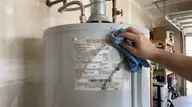
- The age. The serial number on the rating plate (the label on the side of the tank) gives the build date. Enter it in the checker above, or read it by brand on how old is my water heater?. The water heater age cheat sheet (PDF) has every code on one page, handy for a walkthrough. Don’t take off panels to reach the plate.
- Recalls. Enter the model number in our appliance recall check, then confirm on CPSC’s recall site.
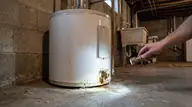
- Look and listen. Water around the base of the tank, rust-colored or smelly hot water at the taps, rumbling or popping while it heats, and less hot water than before are the signs Rheem and Bradford White list.
- Look for the parts the local code may require. From a step back: are there earthquake straps (required in California), a drain pan, an expansion tank on the cold water pipe, and a pipe running down from the relief valve? Whether yours needs each one depends on your local code, so note what you see and ask your inspector or a licensed plumber.
- Paperwork. Ask the seller or landlord when the heater was installed and whether a permit was pulled.
Inspecting for clients? Our page for home inspectors lists the free tools and printables, including a one-page age report for up to eight appliances and water heaters.
Worked example. A Rheem rating plate shows serial RH 0806B17262. Rheem’s code puts the month and then the year after the letters, so “0806” means August 2006. On 30 September 2026 that heater is 20 years old, older than even the top of the 10-to-15-year range the US Department of Energy’s Energy Saver guide gave for tank heaters. Budget for a replacement and have a licensed plumber look at it, whatever the home inspection report says about its condition.
For typical lifespans by type, see how long do water heaters last?. If replacement comes up, our water heater replacement cost estimator gives estimated installed price ranges by type, size and state.
When to call a licensed plumber
- Water pooling around the tank. Rheem calls it “a serious concern”; Bradford White says “Even a small leak means that a water heater will need to be replaced, because leaks are unable to be fixed.”
- Leaks, odors or uneven heating. Rheem: “Any leaks, odors, or inconsistent heating performance should be inspected by a licensed technician right away.”
- Anything involving gas, electrical parts, valves or covers. Hire a licensed plumber (or electrician) rather than doing it yourself.
- If you smell gas, don’t investigate. New Hampshire’s Department of Energy says: “Get out immediately and go to a safe location 300 feet away or more,” don’t use switches or phones inside, and call 911 from there.
Limitations
- Code requirements vary by state, town and code edition. The two checklists are examples, not the rules where you live.
- We quote the standards; your inspector’s agreement and report say what your inspection covered.
- Costs are national trade estimates; the HomeGuide call-fee page is dated 2023.
- None of our sources gives a time for a water heater inspection on its own. ASHI says a whole single-family home inspection usually takes 2 to 4 hours.
- We haven’t inspected any water heater; this page summarizes the sources below.
Checked against the sources below on 30 September 2026; sources added or changed on 6 October 2026 were checked that day.