Start with your busiest hot-water period
Before comparing heaters, write down what happens when your home needs the most hot water. Do two showers run together? Does a dishwasher overlap with bath time? Or does everyone shower one after another?
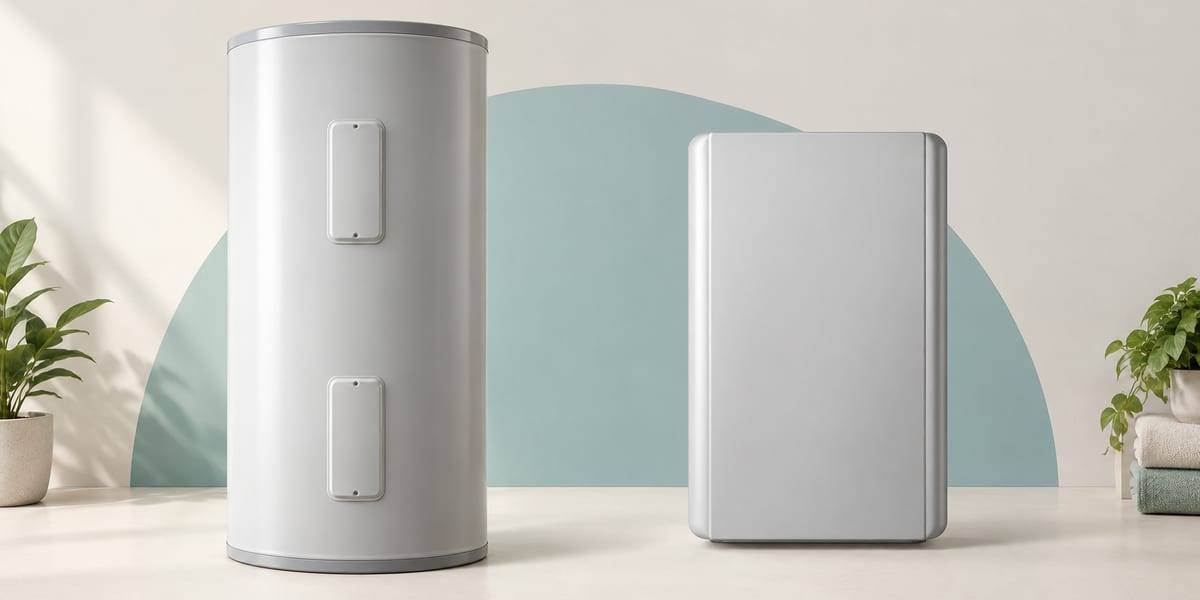
A storage heater has heated water in its tank and replenishes it as you use it. A tankless heater heats flowing water on demand, but the flow it can heat is limited. Back-to-back use and several fixtures running together are different sizing questions.
Basis: manufacturer guidance from A.O. Smith’s residential sizing guide and official ENERGY STAR tankless buying guidance.
Use these prompts for your installer conversation:
- Busiest period: list the showers, baths and appliances normally used around the same time.
- Current problem: describe whether water runs cool during use, takes a long time to arrive, or both. These are observations, not a diagnosis.
- Changes ahead: mention an added bathroom, different bathing habits or other expected demand.
This is our planning checklist, not a sizing calculator. Avoid choosing a capacity from bedroom count or family size alone.
Compare the right capacity measures
The figures on a storage heater and a tankless heater describe different things. Tank gallons and a tankless unit’s headline flow rate are not a direct comparison.
| Option | Measure and question for the installer |
|---|---|
| Storage tank | First-hour rating (FHR): the hot-water volume it can deliver during the first hour, starting with a fully heated tank. Ask: Does this model’s first-hour delivery match our busiest hour? |
| Tankless | Gallons per minute (GPM) at a specified temperature rise: the flow it can heat through the required difference between incoming and delivered water temperatures. Ask: What flow can this model supply for our overlapping fixtures under local winter conditions? |
Basis: official ENERGY STAR definitions and manufacturer A.O. Smith sizing guidance. The questions are our editorial checklist; they are not capacity recommendations.
Have the installer show the proposed model’s performance data. A maximum advertised flow without its temperature-rise condition does not settle the tankless question. Likewise, tank volume alone leaves out how much hot water the storage system can deliver as it recovers.
For a real model comparison and a household worksheet, see what size water heater you need.
Check which options fit your home
A tankless unit’s compact housing can be appealing, but the housing is only part of the installation. For a gas tankless option, ENERGY STAR recommends an in-home assessment of gas supply, electricity and venting. Ask a licensed installer to confirm location, service access and any changes needed for each proposed system before comparing prices.
Basis: official ENERGY STAR gas tankless guidance. An existing fuel connection is not confirmation that conversion will be straightforward.
If your home is all-electric, include heat-pump storage in the discussion. A storage tank does not necessarily mean a conventional electric-resistance heater. Heat-pump models have their own location and operating requirements; ask the installer to check the exact model against the proposed space.
Basis: official ENERGY STAR heat-pump water heater guidance. This page does not prescribe electrical work, venting, clearances or plumbing modifications.
Which options are worth getting quotes for?
Use the following comparison to prepare questions, rather than to pick a winner without a site assessment.
| What matters in your home | Evidence to request before deciding |
|---|---|
| Several fixtures often run together | Compare storage first-hour delivery with the tankless model’s simultaneous-flow performance. Ask how each proposed option meets that demand. |
| Long runs of back-to-back showers | Ask how storage recovery and tankless sustained output would handle your pattern. Check whether other fixtures overlap during that period. |
| You want to reclaim the current tank’s space | Ask whether a tankless option has a suitable location and what conversion work the quote includes. |
| The main complaint is waiting at a distant bathroom | Ask the installer to assess delivery delay before assuming a change of heater type will solve it. |
| You are comparing electric options | Request a heat-pump storage assessment as well as the other suitable electric options. |
Basis: our editorial comparison, drawn from the official and manufacturer guidance above. We have not tested heaters or inspected your home. Both types require selection for the actual demand and site.
Compare the complete quote and upkeep
Once suitable options are identified, use our water heater replacement cost guide for the broader budget and tankless water heater cost guide for conversion and running-cost context. Keep the proposed model and included work beside each written quote so that different scopes are visible.
Ask for the model’s maintenance instructions, warranty requirements and local service cost. Water quality and the chosen product matter; do not assume one flushing or descaling interval applies to every heater. A.O. Smith discusses water quality and maintenance in its tankless comparison; ENERGY STAR also directs heat-pump owners to their manufacturer’s maintenance guidance.
If you are deciding what to do with an existing heater, our water heater lifespan guide separates published averages from an individual unit’s condition. Averages alone cannot decide whether changing heater type is worthwhile.
Take this checklist to your installer
- Bring your busiest-period observations and describe the current problem.
- Ask for the proposed storage model’s FHR or tankless model’s output at the required temperature rise.
- Confirm site suitability, including access and any gas, electrical or venting changes.
- Get an itemized quote showing the model, installation scope and exclusions.
- Ask about model-specific upkeep, warranty conditions and available local service.
- Compare the suitable options against your priorities before committing.
This checklist is our editorial planning aid, not installation advice or a guarantee of savings. For an assessment of an existing system, see water heater inspection options. A licensed professional should handle installation and gas or electrical work.
Checked against the sources below on 10 October 2026. This guide concerns US household selection; it does not recommend a specific model or calculate capacity.