Who buys used appliances, and what each buyer pays
Four kinds of buyer pay for used appliances: private buyers on local marketplaces, used-appliance dealers, some electric utilities (mainly for old fridges and freezers that still work) and scrap metal yards. Private buyers usually pay the most, and scrap yards the least. Charities take working appliances without paying, and retailers haul an old one away, usually for a fee, when they deliver its replacement.
| Buyer | Pays you? | Typically takes | How to find one |
|---|---|---|---|
| Private buyers | Yes, usually the most, since you set the price | Appliances in good condition; say how yours works and note any damage | List it on Facebook Marketplace, Craigslist, OfferUp or Nextdoor; check similar local listings first |
| Used-appliance dealers and refurbishers | Yes, at wholesale: one Nevada buyer lists $25–$100 per appliance | Only the brands and models they want; some test it before making an offer | Map search “we buy appliances” plus your town; text photos and the model number |
| Electric utility recycling programs | Some do: $25–$150 per full-size fridge or freezer in the six programs we checked (Oct 2026) | Working fridges and freezers, usually 10 to 30 cubic feet; none of the six takes washers or dryers | Search your utility’s name plus “appliance recycling” |
| Scrap metal yards | Yes, by weight or per appliance: light iron, the grade most appliances fall under, averaged about $170 a ton in mid-October 2026, under 10 cents a pound | Working or not; federal law requires a fridge or freezer’s refrigerant to be recovered | Search “scrap metal” plus your town; call for that day’s price |
| Charities such as Habitat for Humanity ReStore | No. A tax deduction generally requires itemizing and an appliance in good used condition or better | Working, clean appliances; each store sets its own rules | Habitat’s ReStore finder; most ReStores pick up large items |
| Retailers delivering a new appliance | No. Best Buy and Lowe’s charge about $50; Home Depot lists haul-away as an add-on service | The unit being replaced, disconnected and empty | Add haul-away when you order |
Basis: official pages (utilities, ENERGY STAR, EPA, IRS, Habitat for Humanity, retailers), checked 20 October 2026, with the utility recycling programs re-checked 9 November 2026; marketplace help page (OfferUp); dealer published pages (stores in Nevada, Florida and Maryland); trade estimate for scrap (iScrap App’s US light-iron average). “Usually the most” for private buyers is our assessment, not a measured figure.
Not every used-appliance store buys from the public. Two Maryland stores say they rarely or never buy single appliances from the public and buy in bulk instead; between them, they cite the time involved, condition and the cost of picking up one appliance. A Florida store that does buy inspects and tests each appliance before deciding whether to make an offer. Call before you load anything.
Used fridges and freezers
A working fridge only a few years old usually fetches the most from a private buyer; our used refrigerator price bands help you price it. For an older one that still cools, check your electric utility first. As of 9 November 2026, Entergy Arkansas pays $25 for a working unit at least 10 years old; PSE&G in New Jersey pays $150 for a working unit if you book the pickup by 31 December 2026 and it happens by 13 February 2027 (its standard rebate is $100); and NHSaves in New Hampshire pays $150 for pickups through 31 December 2026. Availability varies by utility, and each program pays only customers of the utilities it names; the Michigan and Massachusetts programs are below. ENERGY STAR also suggests your state energy office, and says some programs pay cash while others give a bill credit.
A fridge that no longer cools is worth little. ENERGY STAR says the average fridge 10 or more years old holds more than 120 pounds of recyclable steel: roughly $10 at mid-October light-iron prices (our estimate). Under EPA rules, the final disposer, such as a scrap yard or landfill, must recover the refrigerant or get a signed statement that someone else did, so ask the yard first.
Used washers
A working washer usually fetches the most in a private sale. See used washer price for bands by age and condition. Dealers buy selectively: the Nevada buyer lists $50–$75 for older direct-drive washers from the brands it takes. None of the six utility programs we checked takes washers. At a scrap yard, iScrap App says a complete washer typically brings $10–$20.
Used dryers
Dryers go to the same buyers as washers, with one extra question: gas or electric? Whirlpool notes that a gas dryer needs a gas hookup and a standard 120-volt outlet, while an electric dryer needs a 240-volt outlet. Not every home has both, so name the type in your listing. The Nevada buyer lists $25–$50 for dryers with the lint filter on top, from the same brands. iScrap App says most dryers count as light iron at scrap yards and typically bring $5–$20. Have a qualified technician disconnect a gas dryer before it’s moved.
Washer and dryer sets
Sell a matching pair together. Angi says matching washer and dryer combos are “generally at the top of the used appliance list.” Ask a dealer for one price for both. For a one-piece stacked washer and dryer, the Nevada buyer lists $75–$100. Our used washer price page has published set prices. To sell a pair near you, post one listing for both and call local used-appliance stores.
Basis for these notes: the official, manufacturer (Whirlpool) and dealer pages above, checked 20 October 2026; trade estimates (iScrap App); editorial guide (Angi). “Usually fetches the most” is our assessment, and the $10 steel value is our estimate: 120 pounds at about $170 a ton.
Your options compared
Fees and terms are as of September 2026, except the utility and scrap figures (October 2026), and can change. Check each platform before you list.
| Option | Speed | Price you get | Effort | Fees | Basis |
|---|---|---|---|---|---|
| Facebook Marketplace (local pickup) | Days–weeks | Highest (you set it) | High: photos, messages, showings | None for local sales; 10% (min $0.80) applies only to shipped orders | official (Facebook Help Center) |
| Craigslist (for sale by owner) | Days–weeks | High | High | Free; $5 only for by-dealer and vehicle categories | official (craigslist) |
| OfferUp (in person) | Days–weeks | High | High | No fee on in-person sales; paid extras optional | official (OfferUp Support) |
| Nextdoor (For Sale & Free) | Days–weeks | Medium–high, neighbors only | Medium | No selling fee listed in its help pages | official (Nextdoor Help) |
| Used-appliance dealer that buys | Fast (offer by text or visit) | Low (wholesale) | Low | None, but you get a buyer’s price | dealer page |
| Utility recycling program (some areas only) | Scheduled pickup | $25–$150 in the six programs we checked, Oct 2026 (working fridges/freezers only) | Low: they pick up | Free pickup | official (utilities) |
| Retailer haul-away with a new purchase | Delivery day | $0 (you pay) | Lowest | Best Buy $49.99, Lowe’s $50 | official (retailers) |
| Donation (Habitat ReStore, charities) | Pickup or drop-off | $0 (possible tax deduction) | Low–medium | Some stores charge (e.g., $20 at Fort Collins) | official (Habitat affiliates) |
| Scrap or bulky-item collection | Depends on your town | A few dollars to about $20 at a scrap yard; $0 from town pickup | Medium | Varies by town | official (EPA); trade estimate (iScrap App) |
Speed and effort ratings are our own qualitative estimates. Fees and payments come from the official pages cited; the scrap figure is a trade estimate (iScrap App).
How to find who buys used appliances near you
- Search locally. In a map app, try “used appliance store”, “we buy appliances” or “appliance buyer” plus your town. Check that the store buys from the public, and which brands: the Reno buyer below takes only Whirlpool, Maytag, Amana, KitchenAid and some Kenmore.
- Send the details first. Text or email the brand, model and serial number, the age, whether it works, and photos of the label, inside and outside. Our age checker reads the build date from the serial number. Ask what they’ll pay, and whether they pick up.
- Check your electric utility. Search its name plus “appliance recycling”. Some utilities pay for working old fridges and freezers; see the utility programs below.
- Compare with a private sale. A local listing usually pays more than a dealer. Our value guide shows how to set a price.
- If no one will pay, donate it or have it hauled away. Habitat for Humanity’s ReStore finder searches by ZIP code, and your town’s bulky-item pickup or a scrap recycler may take a unit that doesn’t work.
Selling it yourself: marketplaces
Facebook Marketplace. Facebook’s Help Center says its selling fee of 10% (or $0.80 minimum) applies to orders with shipping. Almost nobody ships a fridge, so a local-pickup sale costs you nothing in platform fees.
Craigslist. Craigslist says all postings are free except the categories it lists. The paid ones include $5 for “all for sale by-dealer categories in the US” and $5 for cars, trucks, RVs and motorcycles by owner. An appliance listed by its owner is free.
OfferUp. OfferUp says it doesn’t charge fees or take a commission on in-person transactions. It charges for optional extras such as promotions and additional listings once you’ve used your free monthly allotment. OfferUp ended nationwide shipping in October 2025 and now supports only local, in-person sales.
Nextdoor. Nextdoor’s For Sale & Free section is for personal items. Its rules don’t allow resellers or selling for a business. Its seller tips recommend leaving your phone number, email and home address out of the post and sharing contact details in chat.
On any marketplace, lead with what buyers check: the model number, the age (from the serial number), whether it’s working, and photos of the inside. See our buying checklist for the tests buyers will run.
Who buys used appliances for cash: dealers
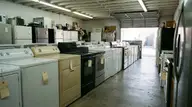
Some used-appliance stores buy stock from the public. They’re fast, but they pay wholesale because they have to test, clean, warranty and resell the unit.
One example, a Reno and Sparks, Nevada buyer, publishes what it pays: washers $50–$75, refrigerators $50–$100, dryers $25–$50, and stacked units $75–$100. It takes only Whirlpool, Maytag, Amana, KitchenAid and some Kenmore brands, and says not every appliance will be purchased. Compare that with the $175–$500 a South Carolina dealer charges for used washers, and you can see the dealer’s margin. Details are on our used washer price page.
Retailer haul-away when you buy new
If you’re replacing the appliance, the store delivering the new one will usually take the old one away for a fee:
- Best Buy: $49.99 to haul away and recycle one major appliance when it delivers a replacement. Anything not being directly replaced with installation must be disconnected before the crew arrives.
- Lowe’s: $50 when your new appliance is delivered. It’s free for select MyLowe’s Pro Rewards members.
You get nothing for the old unit, but it’s the least effort.
Donating: Habitat for Humanity ReStore and charities
Habitat for Humanity says its ReStores accept “new and gently used appliances”. It notes that each ReStore is different and many offer free pickup of large items. Local rules vary a lot:
| ReStore | Appliance rule |
|---|---|
| Habitat Capital District (NY) | Good working order and under 10 years old; new dishwashers and water heaters only |
| Fort Collins Habitat (CO) | Full working order and clean; no plastic-tub dishwashers; $20 processing fee per large appliance |
Basis: official, each ReStore’s own page.
Call your local ReStore before you load the truck.
Utility recycling programs (old fridges and freezers)
Some electric utilities pay you to retire a working fridge or freezer, and pick it up free. These programs are local, and each pays only the customers it names. The three below cover parts of Michigan and Massachusetts:
| Utility | Payment | Main conditions |
|---|---|---|
| DTE Energy (MI) | $50 gift card (10–30 cu ft), $100 for pickups booked 19 Oct–20 Nov 2026; $20 for units under 9.9 cu ft | DTE residential electric customer; working, clean, empty, defrosted; limited funds, first come, first served |
| Consumers Energy (MI) | $50 | Consumers electric customer; empty, working, 10–30 cu ft |
| National Grid (MA) | $75 | Massachusetts electric customer of National Grid, Eversource, Unitil or Cape Light Compact; working, cooling and empty at pickup; 10–30 cu ft; pickup during 2026; max two per type per year |
Basis: official, each utility’s program page.
If your utility isn’t listed, EPA’s advice is to check first with your electric utility for a rebate or “bounty” (turn-in) program, and to check its rules, which can require a working unit of a minimum age or size. Search your own utility’s name plus “appliance recycling”. EPA’s own partnership with utilities and retailers, the Responsible Appliance Disposal (RAD) program, ran from 2006 to 2025.
For a fridge that’s old but still cold, a utility payment, where there is one, sets a floor. If a marketplace buyer offers less than your utility pays, take the rebate.
Scrap and bulky-item pickup
For appliances that don’t work, your town’s bulky-item collection or a scrap-metal recycler may take them. For refrigerators and freezers, EPA says the final disposer, such as a scrap recycler or landfill, is responsible for recovering the refrigerant. Some towns require it removed before pickup; EPA says you would then need a professional, such as an employee of an appliance repair shop, to remove it. Don’t try to remove refrigerant or a compressor yourself. EPA also warns that appliances left at the curb may be landfilled or disposed of unsafely, so schedule a collection instead.
How to price it
Start with what it cost new, its age and its condition. Our used appliance value guide explains the method and the evidence. As a rule of thumb, resale marketplace Commonplace puts most everyday used goods at 20–40% of original retail, and 50–70% if like-new. Check local listings for the same style and size, then price to sell within a week or two.
Safety tips for sellers
- Check for recalls before you list. CPSC says it is illegal to sell any recalled product and that it’s the seller’s responsibility to check. A recalled product can be sold if it has been repaired in accordance with the recall. Use the appliance recall check.
- Take payment before the item leaves. OfferUp says cash is the safest method and warns against checks, gift cards, wire transfers and cryptocurrency.
- Refuse overpayments. The CFPB says a buyer who sends a check or money order for more than the price and asks for the difference back is running a common scam.
- Be careful with strangers at your home. Nextdoor’s guidance is to be appropriately cautious. Consider having someone with you when a buyer visits.
- Disconnect safely. Gas appliances and hard-wired units should be disconnected by a qualified technician before pickup.
Limitations
Fees, rebates and donation rules change and vary by location. The utility and ReStore examples above are specific programs, not national rules. Dealer prices come from single stores’ published pages.
What to do next
- Estimate a fair asking price: how much is my used appliance worth.
- Price bands for common sales: used washer price and used refrigerator prices.
- Confirm it isn’t recalled: appliance recall check.
Checked against the sources below on 6 October 2026. The buyer comparison at the top was added and checked against its sources on 20 October 2026, and the utility recycling programs were re-checked on 9 November 2026.