How long does a water heater take to heat up? For a full tank of cold water, a typical gas tank needs about half an hour to an hour, and an electric tank about one to two hours. The exact time depends on the fuel, the tank size, the burner or element rating and how cold the incoming water is.
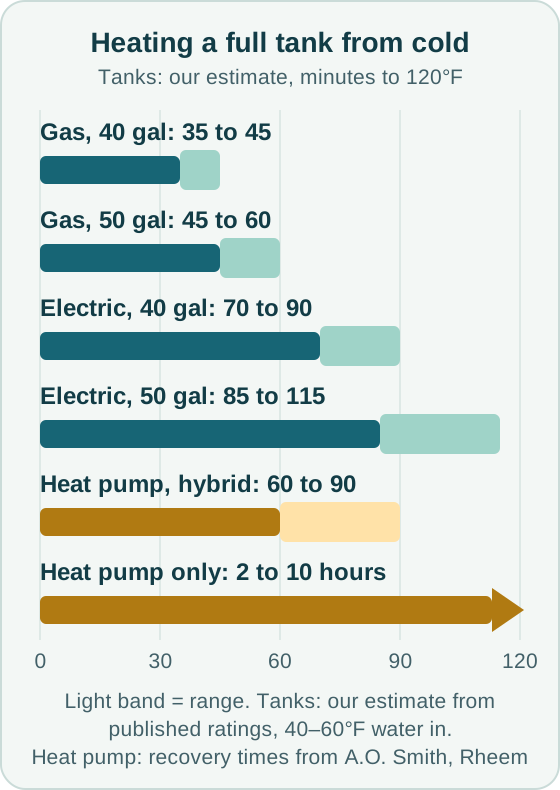
Heat-up times at a glance
| Heater | Time to heat a full tank |
|---|---|
| Gas tank (A.O. Smith) | 30 to 40 minutes |
| Electric tank (A.O. Smith) | 60 to 80 minutes from empty; 60 to 90 after heavy use |
| Gas, 40 gal, 40,000 BTU/hr (our estimate) | About 35 to 45 minutes |
| Gas, 50 gal, 40,000 BTU/hr (our estimate) | About 45 to 60 minutes |
| Electric, 40 gal, 4,500 W (our estimate) | About 70 to 90 minutes |
| Electric, 50 gal, 4,500 W (our estimate) | About 85 to 115 minutes |
| Heat pump, hybrid mode (A.O. Smith) | 60 to 90 minutes |
| Heat pump only mode (Rheem) | 2 to 10 hours |
| Tankless | No tank to heat |
Basis: manufacturer figures from A.O. Smith’s heat-up guide and reheat guide, and Rheem’s heat pump modes article. Rows marked “our estimate” are our arithmetic from published spec sheets, explained below, rounded to the nearest 5 minutes. We have not tested any heater.
How we estimated the times
A tank heater’s recovery rate is, in A.O. Smith’s words, “the gallons of hot water that the water heater can heat by 90 degrees F in 1 hour from cold” (sizing guide). Spec sheets publish it, so we used them:
- Gas: Bradford White’s 40- and 50-gallon atmospheric models with a 40,000 BTU/hr burner (RG240T6N and RG250T6N) are rated at 43 gallons per hour at a 90°F rise. Their rated storage is 38 and 48 gallons (spec sheet 1101).
- Electric: Rheem’s Professional Classic 40- and 50-gallon tall models (PROE40 and PROE50 T2 RH95) are rated at 21 gallons per hour at a 90°F rise with 4,500-watt elements. Their rated capacity is 36 and 45 gallons (Rheem spec sheet). Bradford White lists the same 21 gallons per hour for a 4,500-watt element (spec sheet 1201).
Our method: minutes = rated gallons × temperature rise ÷ (recovery rate × 90) × 60. We assumed heating to 120°F, the usual factory setting according to A.O. Smith, from incoming water at 60°F (a mild month) and 40°F (a cold winter). A.O. Smith puts winter supply water at 40 to 50°F and summer at 60 to 70°F.
The physics behind it. One BTU raises one pound of water by 1°F (EIA), and a gallon of water weighs about 8.33 pounds (USGS). So:
- Gas, 50 gallons, winter: 48 gal × 8.33 lb × 80°F = about 32,000 BTU. A 40,000 BTU/hr burner at the “up to 80%” recovery efficiency on Bradford White’s sheet delivers about 32,000 BTU/hr, so roughly one hour.
- Electric, 50 gallons, winter: 45 gal × 8.33 lb × 80°F = about 30,000 BTU. One 4,500-watt element supplies about 15,350 BTU/hr (1 kWh = 3,412 BTU, per EIA). Assuming nearly all of it goes into the water, that is about two hours.
Basis: our estimate, using published ratings and standard conversions. Rheem’s sheet gives the same idea as a formula: recovery = wattage ÷ (2.42 × temperature rise).
Our full-tank figures are longer than A.O. Smith’s general ones. For example, A.O. Smith says a 50-gallon gas heater with a 40,000 BTU burner “can recover completely in about 35 minutes”. It doesn’t state the temperature rise behind that figure. Ours assume the whole tank starts at the incoming-water temperature, which is the slowest case. Even at A.O. Smith’s own 40 to 50 gallons per hour, a full 50-gallon tank raised 90°F would take about an hour or more.
After installation or a refill
A newly installed or refilled tank is the slowest case: every gallon starts cold. A.O. Smith says gas tanks generally heat up in 30 to 40 minutes from empty, and electric tanks take about 60 to 80 minutes. It also says “a new water heater should deliver the recovery times stated in your manufacturer’s handbook.”
Starting up a new or drained heater is the installer’s job. Gas lighting and electrical work belong with a licensed plumber or electrician, following the model’s manual.
How long for hot water to come back after you run out
According to A.O. Smith, most gas tanks reheat a full tank in 30 to 40 minutes after you’ve used up the hot water, and electric tanks need 60 to 90 minutes. If you only used part of the tank, there is less cold water to heat: A.O. Smith says that if you used half the tank, the reheat time is roughly half.
How much hot water you get in a busy hour is a different number: the first-hour rating. ENERGY STAR defines it as the hot water a storage heater can supply in an hour, starting fully heated (ENERGY STAR glossary). A.O. Smith says it accounts for both tank capacity and recovery rate. If you run out often, see what size water heater you need.
Gas vs electric: why electric takes longer
A.O. Smith says gas heats water two to three times faster than standard electric heating. Gas tanks typically recover 40 to 50 gallons per hour, electric tanks 15 to 20.
The spec sheets show why. The Bradford White and Rheem spec sheets we checked list 4,500-watt elements, and as standard only one heats at a time (Bradford White calls this non-simultaneous operation; Rheem’s recovery figures assume it). A bigger gas burner recovers faster: Bradford White’s 50-gallon model with a 50,000 BTU/hr burner is rated at 54 gallons per hour, against 43 for the 40,000 BTU/hr version.
Heat pump water heaters
A heat pump water heater is slower in its most efficient mode. ENERGY STAR’s 2024 heat pump guide says heat-pump-only mode “will take significantly longer to recover than hybrid mode.” Rheem puts full recovery in heat pump mode at 2 to 10 hours, depending on the air and incoming water temperatures. A.O. Smith says hybrid mode speeds recovery to 60 to 90 minutes.
In hybrid mode, the heater switches to its electric elements during high demand (ENERGY STAR). ENERGY STAR’s heat pump water heater technical guide also notes that intake air below about 40°F triggers the elements and lowers efficiency. Your manual explains the modes on your model.
Tankless water heaters
A tankless heater doesn’t store water, so there is nothing to reheat. A.O. Smith says it heats water as it flows through the unit. Its limit is flow: typical gas tankless units deliver about 5 to 10 gallons per minute and electric ones about 2 to 5 (A.O. Smith). For comparison, ENERGY STAR lists an average shower at 2.5 gallons per minute (ENERGY STAR).
Colder incoming water cuts the hot-water volume a tankless unit produces in winter, according to A.O. Smith. You still wait for hot water to reach the tap: the closer the heater is to the faucet, the sooner it arrives. More in tank vs tankless water heater.
Why is my water heater taking longer than normal?
A.O. Smith’s reheat guide lists these causes:
- Cold incoming water in winter. The seasonal difference can add 15 to 30 minutes to recovery.
- Sediment. Buildup at the bottom of the tank acts like insulation between the heat source and the water.
- A failing electric element. The lower element does most of the reheating, so its failure hurts recovery most.
- A thermostat problem. The heater may shut off before the water is fully hot.
- An undersized heater. It recovers slowly while working correctly; the fix is a better-sized heater, not a repair.
A heat pump model left in heat-pump-only mode, or in a cold room, will also recover more slowly (see above).
Age matters too. A.O. Smith: “For water heaters aged 10 years or older, long recovery times could be a sign you need a replacement.” Find your heater’s build date with our water heater age checker, and compare it with how long water heaters last.
Don’t open element panels, adjust a gas valve or work on the burner yourself. Hire a licensed plumber for gas heaters and a licensed electrician or plumber for electric ones.
What to do next
- Check the rating plate for the tank size and the burner BTU/hr or element wattage, and compare with the table above.
- Note whether it is slow all year or only in winter.
- If it is 10 years or older, check its age and lifespan before paying for repairs.
- If you are replacing it, see water heater replacement cost and what size water heater you need.
Checked against the sources below on 14 October 2026. Times are general estimates for US household heaters, not a test or a prediction for one heater.