Model number or serial number: which one do you need?
Both are printed on the same label, usually one above the other. They do different jobs.
| Model number | Serial number | |
|---|---|---|
| What it identifies | The product: size, fuel, features, configuration | Your individual unit |
| Shared with other units? | Yes, every unit of that model | No, it is unique |
| Carries the build date? | No | Yes, on most major brands |
| Use it for | Parts, manuals, spec sheets, registration, warranty claims, recall notices | Manufacture date, and confirming your unit falls inside a recall’s affected range |
| Typical look | Letters and digits, often with a trailing revision digit, e.g. WTW5000DW1 | A plant or date code plus a run number, e.g. C60842986 |
Basis: manufacturer support pages (Whirlpool, Maytag, KitchenAid, GE, LG, Samsung, Frigidaire, Bosch) and Sears PartsDirect’s model-number guide.
If you’re trying to work out how old something is, you want the serial number — use the appliance age checker or the brand guides. If you’re buying parts, downloading a manual, registering the appliance or checking a recall, you want the model number, and the recall check above takes it directly.
Where the label is, by appliance
Open the door or lid first. On most appliances the label sits on the frame around the opening, where you only see it when the door is open.
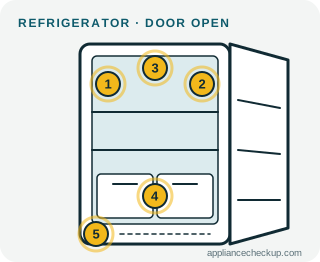
- Upper left wall of the fresh-food section (Whirlpool, Maytag, KitchenAid, Frigidaire top-freezer; Samsung French-door and side-by-side; newer LG models)
- Upper right wall (LG on most models; Frigidaire French-door and side-by-side; Whirlpool and Maytag side-by-side)
- Ceiling of the fresh-food section (GE, Kenmore, KitchenAid quad-door)
- Beside, behind or under the crisper drawers (GE, Kenmore)
- Outside, low on the front (a second label on Samsung; GE bottom front edge on some models)
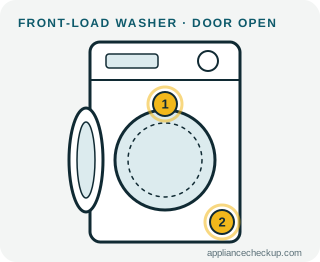
- On the rim, trim or frame of the door opening, often at the top (Whirlpool, Maytag, LG, Samsung, Frigidaire, GE)
- Outside, lower right front corner (some GE models)
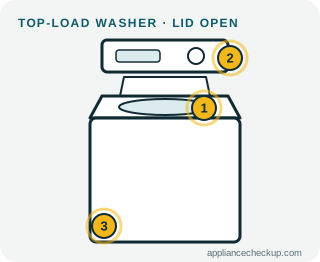
- Under the lid, on the tub rim or the back of the opening (Whirlpool, Maytag, Frigidaire, LG, GE near the right hinge)
- Back of the control panel or the back panel (GE, LG; Samsung top-loaders on the back)
- Outside, lower corner of the cabinet (some GE models)
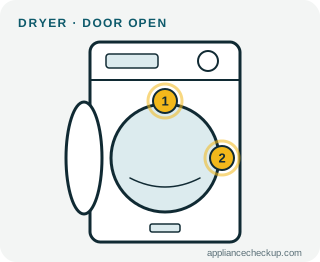
- Rim of the door opening, often at the top (Whirlpool, Maytag, Samsung; LG and Frigidaire say the top)
- Left or right side of the drum opening (GE). Ventless Whirlpool and Maytag dryers: behind the water tank
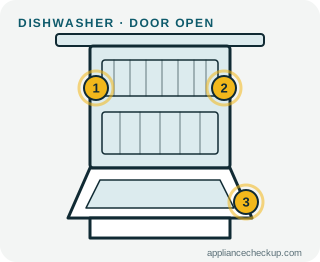
- Left edge of the tub frame (Whirlpool, Maytag, KitchenAid, GE, Samsung)
- Right edge of the tub frame (GE, Frigidaire, Samsung)
- Side or top edge of the door, or its inside (LG, GE, Frigidaire, Bosch, Samsung)
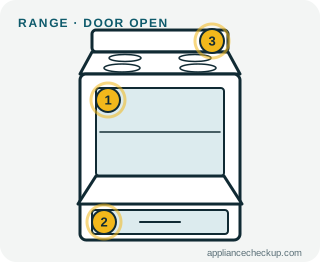
- Oven frame or side trim, seen with the door open (Whirlpool, Maytag, Frigidaire, GE, LG)
- Frame of the storage drawer, with the drawer pulled out (Whirlpool, Maytag, Frigidaire, LG, GE)
- Under the cooktop or behind the control panel on some models (GE; Frigidaire and Maytag cooktops underneath)
Basis: Official manufacturer help pages (Whirlpool, Maytag, KitchenAid, GE, LG, Samsung, Frigidaire, Bosch) and Sears PartsDirect for Kenmore. Diagrams are simplified; your model's exact spot can differ.
| Appliance | Where manufacturers say to look |
|---|---|
| Refrigerator | Inside the fresh-food compartment: the upper side wall, the ceiling, or the frame behind the crisper drawers. Whirlpool and Maytag put side-by-side labels on the right-hand side and top- and bottom-freezer labels on the left; other brands vary |
| Front-load washer | Inside the door, on the rim of the opening |
| Top-load washer | Under the lid, on the tub rim; some models put it on the back of the control panel |
| Dryer | Inside the door opening, or in front of the lint screen, or on the back panel |
| Dishwasher | On the edge of the tub frame or the side or top edge of the door, with the door fully open; sometimes behind the kickplate |
| Range or cooktop | On the oven door frame, on the frame behind the storage drawer, or under the cooktop |
| Wall oven | Top of the oven cavity, or on the front frame around the opening (some brands put it at the bottom left); on double ovens, usually the lower oven |
| Over-the-range microwave | On the front frame, with the door open |
Basis: official manufacturer help pages (Whirlpool, Maytag, KitchenAid, Amana, GE, LG, Samsung, Frigidaire, Bosch) and Sears PartsDirect. Your model’s own manual gives the exact spot.
Where the label is, by brand
| Brand | What the label is called | Full guide |
|---|---|---|
| Whirlpool | Model and serial number | Whirlpool serial number lookup |
| Maytag | Model and serial number | Maytag serial number lookup |
| KitchenAid | Model and serial number | KitchenAid serial number lookup |
| Amana | Model and serial number | Amana serial number lookup |
| GE, Hotpoint, Café, Monogram | Model and serial number | GE serial number lookup |
| Frigidaire, Electrolux | Model and serial number | Frigidaire serial number lookup |
| LG | Model and serial number | LG serial number lookup |
| Bosch, Thermador | E-Nr (model), FD (production date), Z-Nr (serial) | Bosch serial number lookup |
| Kenmore | Model number with a three-digit maker prefix | Kenmore serial number lookup |
| Samsung | Model code and serial number | How old is my refrigerator |
Basis: official manufacturer help pages, listed in the sources below.
Two brands that label things differently
Bosch and Thermador don’t print “model number”. They print E-Nr, short for Erzeugnisnummer, with a version number after the slash. The FD number is the production date, and Z-Nr (Zähl-Nummer) is the individual serial number. On a Bosch rating plate, the number you want for parts and recalls is the E-Nr; the number you want for the build date is the FD. Basis: Bosch’s own product-number documentation.
Kenmore model numbers start with a three-digit prefix before a dot, such as **110.**20622991. That prefix is not decoration: it identifies the manufacturer that actually built the unit, because Sears never made Kenmore appliances itself. 106 and 110 are Whirlpool, 253 is Frigidaire, 795 is LG and 363 is GE. You need the prefix before you can decode a Kenmore serial at all. The Kenmore guide has the full table.
What you can actually do with a model number
- Check for recalls. This is the most valuable use, and it’s free. Paste the model number into the recall check above, which searches the US Consumer Product Safety Commission’s published recall data, then confirm on the official notice at CPSC.gov. Recall notices list affected model numbers and often a serial or date-code range, so you need both numbers to be sure.
- Buy the right part. Parts sites and manufacturer parts catalogues are organised by model number, including the trailing revision digit. Use the full model number exactly as printed, including any trailing digits, when you search a parts catalogue.
- Download the manual or spec sheet. Manufacturer support sites look manuals up by model number.
- Register the appliance or make a warranty claim. Manufacturers ask for the model number and the serial number together.
- Find out who really made it. Relevant for Kenmore, and for house brands generally.
- Settle the decade on an ambiguous serial. See below.
Can you get the age from the model number?
Not on its own. The date code lives in the serial number, not the model number, on every brand we decode.
The model number is still useful for age, in one specific way. Most serial date codes repeat: Frigidaire’s and LG’s every 10 years, GE’s every 12, Samsung’s every 20, the legacy Maytag code every 24 and Whirlpool’s every 30. So a serial often decodes to two or three possible years. A model number, by contrast, is typically only in production for a few years. Looking the model up in the manufacturer’s support site, and checking the print date on the manual it returns, is usually enough to tell you which of the candidate years is the real one.
That’s the workflow the checker uses too: it shows every plausible date, newest first, and tells you to settle the decade with the model number, the manual’s print date or the purchase paperwork.
If you can’t find the label
- Look again with a flashlight and your phone camera. These labels are small, often white-on-grey, and frequently tucked behind a door seal or a drawer. Photographing the spot and zooming in beats squinting at it.
- Check the paperwork. The manual, the original receipt, the delivery ticket, a protection-plan document or the product-registration email all normally carry the model number.
- Try the manufacturer’s model finder. Whirlpool, Maytag, KitchenAid, Amana, GE, LG, Samsung, Frigidaire and Bosch all publish a page or tool showing exactly where the label sits for each appliance type. They are linked in the sources below.
- Contact the manufacturer. If the label is gone entirely, customer support can sometimes identify a unit from photographs or from a purchase record.
- Don’t guess from the appearance of the unit. A model number you invent or approximate will return the wrong parts and the wrong recall answer.
Limitations
- Label positions vary by model and by production year. The tables above are the spots manufacturers list most often, not a guarantee for your specific unit.
- A model number tells you what the appliance is, not what condition it’s in and not how it was used.
- Not every appliance in a recall notice is affected. Recalls are usually limited to a serial number or date-code range within a model, which is why you need both numbers.
- We don’t decode model numbers into features or build years. Model-number structures differ by brand and change over time, so use the manufacturer’s own lookup for that.
What to do next
- Check the model number against recall notices: use the tool above, then appliance recall check
- Get the age from the serial: appliance age checker or the brand guide for your make
- Buying used? Used appliance buying checklist
- Work out a fair price: how much is my used appliance worth
Checked against the sources below on 26 September 2026.