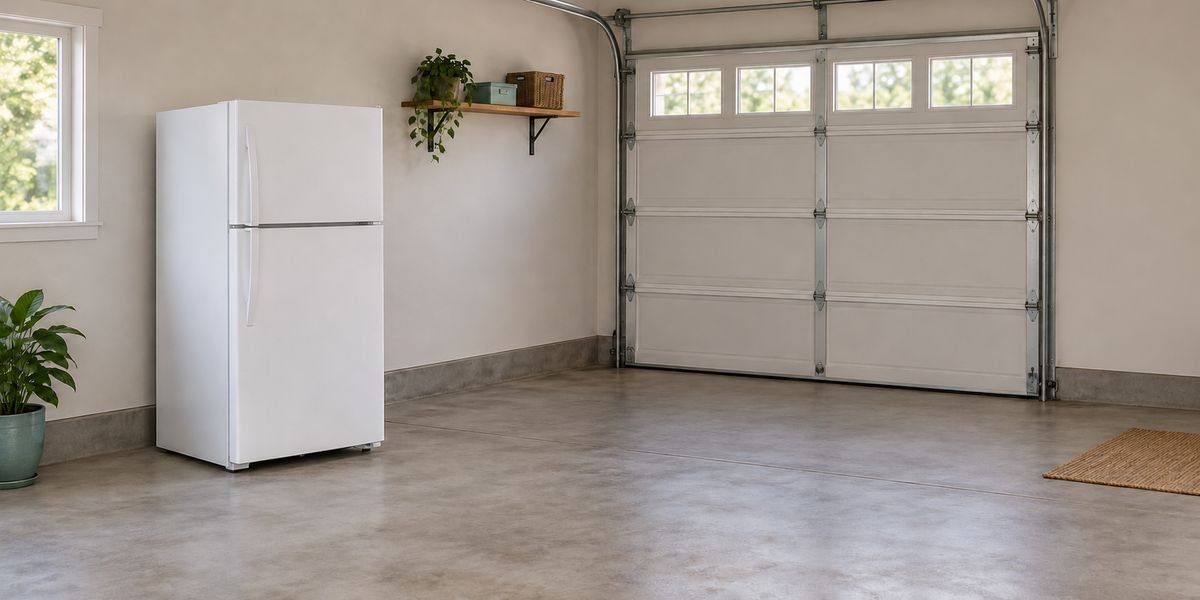
Can a garage-ready refrigerator go inside the house?
Yes, a garage-ready model can be an indoor option. Whirlpool explicitly describes its WRTX5118TZ refrigerator as suitable for a kitchen today and a garage later. The label is not a requirement to keep it in a garage.
Still check the proposed space against that model’s instructions: ventilation clearance, door opening and the room’s temperature all belong in the decision. A refrigerator that fits through the doorway may still need more space around it in its final position.
Basis: manufacturer WRTX5118TZ product guidance and the location requirements in Whirlpool’s owner’s manual. Always obtain the manual for the complete model number you are considering.
Garage-ready is not the same as outdoor-rated
An enclosed garage and a covered patio are different locations. Do not treat “garage-ready” as permission to put a refrigerator outside. For example, Whirlpool’s cited manual limits use to indoors and a covered indoor garage; it also says garage-ready applicability varies by model.
If you want a fridge on a porch or patio, look for explicit manufacturer approval for that exact outdoor use. A roof alone does not change an indoor-only instruction.
Basis: manufacturer Whirlpool location requirements, printed page 5. This is a location check, not a universal weather-resistance rating.
Use this order before deciding whether a spare fridge belongs in the new space:
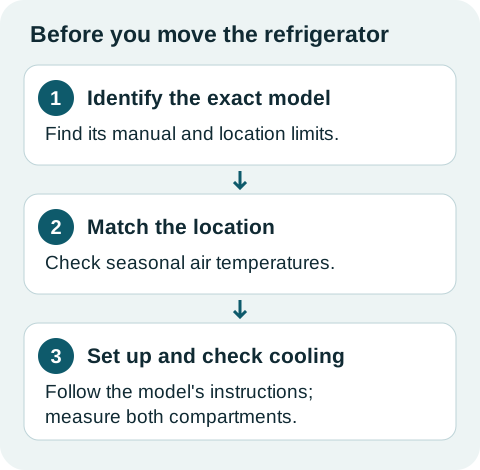
Basis: our editorial decision path, based on the manufacturer and FDA guidance cited on this page. An unknown model or missing location instruction is a reason to ask the manufacturer before proceeding.
Check the surrounding temperature, not just today’s weather
The operating range describes the air around the refrigerator, not the temperature you should set inside it. Compare the manufacturer’s limits with conditions where the appliance will stand, including seasonal lows and highs. A single comfortable-day reading does not describe the full year.
Here are two documented examples, not a universal garage-fridge specification:
| Manufacturer example | Published surrounding-air range |
|---|---|
| GE garage-ready top-freezer models covered by its support article | 38°F to 110°F |
| Whirlpool WRTX5118TZ, with its garage-ready feature | 38°F to 110°F |
Basis: manufacturer GE garage-ready guidance and Whirlpool WRTX5118TZ specifications, checked 10 October 2026. The matching ranges do not prove other models have the same limits.
For these examples, a garage that drops below 38°F falls outside the cited range. “Garage-ready” does not make either example a below-freezing appliance. If your space exceeds the model’s limits, pause the purchase or move until you have a suitable location or a model whose documentation covers those conditions.
Keep the appliance type straight, too: use documentation for your refrigerator, not a separate chest freezer or another product with a similar marketing label.
Check whether the model needs a garage setting
Some Whirlpool models have a separate garage mode for colder surrounding temperatures. Its product-help guide distinguishes that mode from the recommended setting for warmer rooms and tells owners to follow their product documentation.
That means moving a fridge from a garage into the kitchen is also a reason to revisit the manual’s control instructions. Do not copy a knob position from another model. GE’s garage-ready guidance likewise includes control adjustments for its covered top-freezer models.
Basis: manufacturer Whirlpool garage-mode guidance and GE top-freezer guidance. No common setting applies to all garage-ready refrigerators.
What about the old kitchen refrigerator?
Do not assume a working kitchen fridge is suitable for an unheated garage. GE advises against locations below 60°F for non-garage-ready refrigerators unless their owner’s manual or installation instructions say otherwise. That is GE’s guidance, not a temperature limit for every maker.
Cold surroundings can alter how a conventional refrigerator cycles, while hot surroundings can create cooling problems. Whirlpool explains these issues in its garage-ready guide. A freezer that is getting warm in a cold garage therefore needs the location checked as well as the appliance; this page cannot diagnose a fault.
Basis: manufacturer GE installation guidance and Whirlpool’s explanation. Do not add a heater kit or modify the appliance based on generic advice. GE specifically advises against aftermarket garage/heater kits in its cited guidance; ask the manufacturer about the exact model instead.
Before buying or relocating: five checks
Use this short checklist with the seller, manual or manufacturer:
| Check | What to record |
|---|---|
| Exact identity | Full model number, not just brand, capacity or a “garage fridge” listing title |
| Approved location | Indoor room, enclosed garage or explicitly approved outdoor location |
| Seasonal conditions | Expected low/high surrounding temperatures, compared with the model’s range |
| Space and controls | Required clearances, door opening and any model-specific garage-mode instructions |
| Cooling in use | Actual refrigerator and freezer readings after following the setup instructions |
Basis: our editorial checklist, combining the sources above. Use the model-number guide to identify the appliance. For a used purchase, the buying checklist covers condition checks that a location rating cannot answer. The refrigerator age finder is a separate check; age does not confirm garage suitability.
Check food temperatures separately
Use an appliance thermometer in each compartment. FDA recommends keeping the refrigerator at 40°F or below and the freezer at 0°F or below, with regular checks. Those are internal food-storage temperatures, not the surrounding-air range in the example table.
A lit display or a garage-ready label does not replace these readings. If temperatures are unsuitable, protect the food and follow the manufacturer’s troubleshooting or service route. If food has warmed, use FDA’s food-safety guidance; do not assume cooling it again makes it safe.
Basis: official FDA guidance. We have not tested these appliances or inspected your proposed location.
Checked against the sources below on 10 October 2026.