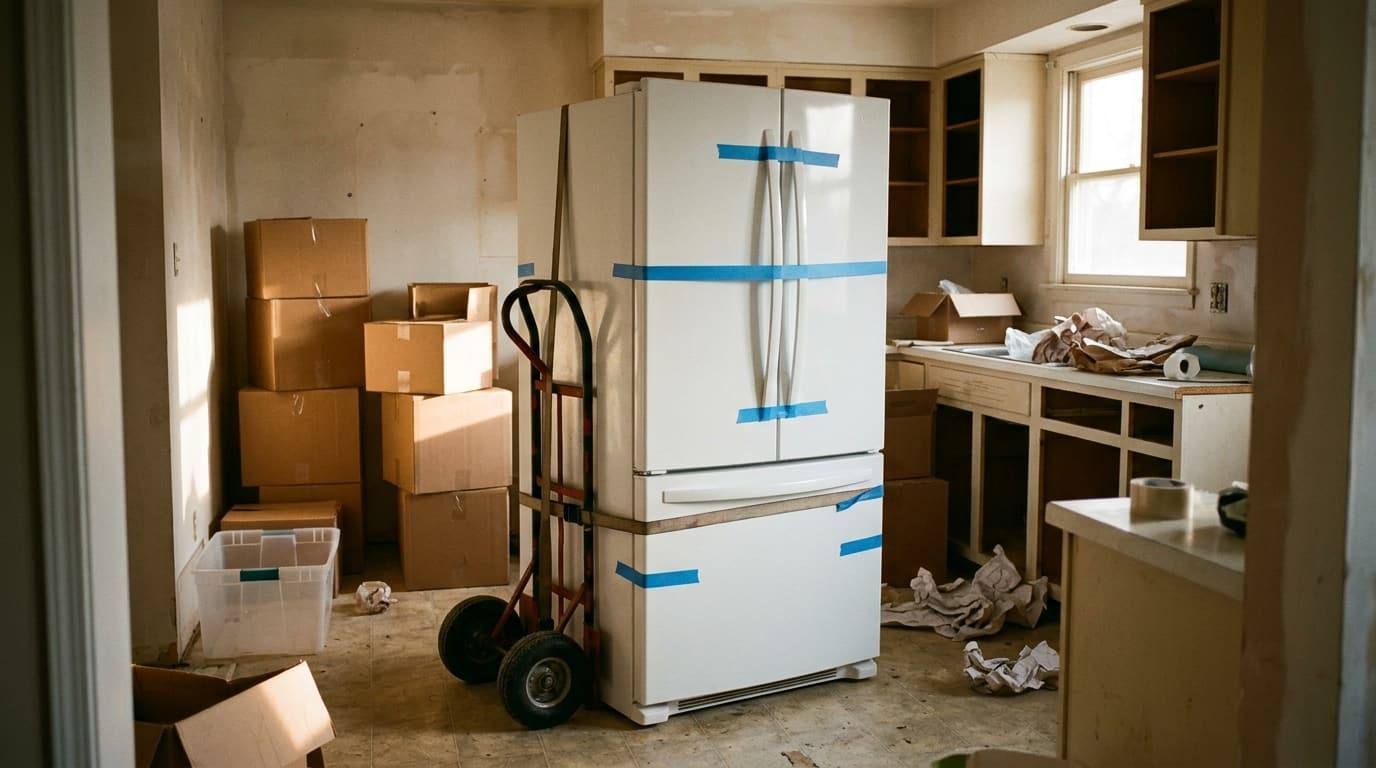
Two checkpoints, not one countdown
A refrigerator can be ready to connect to power without being ready for groceries. Treat these as separate decisions:
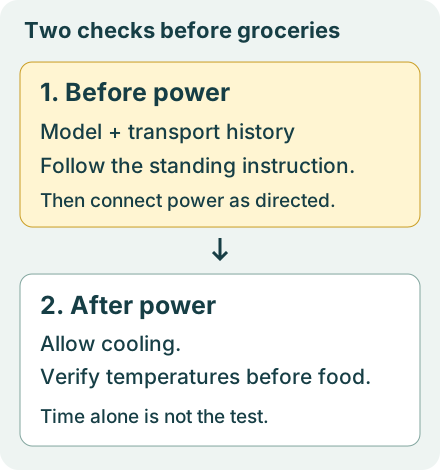
This is our planning sequence, based on the manufacturer and FDA guidance below. The illustration does not assign a universal waiting time.
Before power: check the model and the journey
Record whether the refrigerator stayed upright, was briefly tilted, or lay on its side, and for how long. Find the complete model number using our label-location guide, then read that model’s moving and startup instructions.
Do not choose a waiting time from the brand name alone. Here are examples of why the conditions matter:
| Published guidance | Condition and instruction |
|---|---|
| GE moving guidance: covered side-transported models, such as top-freezer or side-by-side | Stand upright for as long as it was on its side; if that exceeded a day, stand upright for 24 hours before running. |
| GE French-door, bottom-freezer and built-in guidance | Vehicle transport must remain upright; a waiting period is not permission to ignore that restriction. |
| Whirlpool’s cited side-by-side moving guidance | Specifies at least 24 hours upright for Refrigerant 12 units, versus at least 15 minutes for R-134A units. These are not rules for every refrigerant or model. |
Basis: official GE moving instructions and Whirlpool side-by-side guidance, checked 11 October 2026. GE distinguishes brief doorway tilting from vehicle transport; use the exact model’s instructions for your circumstances.
If the model, refrigerant or journey is unknown, ask the manufacturer with a photo of the rating label and what you know about the move. Do not assume a longer wait repairs transport damage. This guide does not provide lifting, wiring, water-line or sealed-system repair instructions.
After power: allow cooling before loading food
Once the model’s standing and installation requirements are met, follow its startup controls and allow it to cool. Whirlpool’s guidance for newly installed refrigerators allows up to 24 hours for full functionality. It explains that room temperature, starting temperature, model and door openings affect cooling time.
That guidance helps with planning; it does not prove an individual used refrigerator is working correctly. Use an appliance thermometer to check actual temperatures, as FDA recommends:
- Refrigerator: 40°F or below.
- Freezer: 0°F or below.
These are storage checks, not instructions to set every refrigerator’s control to 40°F. Follow its recommended settings; Whirlpool’s cited startup guidance uses 37°F for the refrigerator and 0°F for the freezer. Keep any stricter model-specific startup requirements too.
Basis: Whirlpool cooling guidance and FDA thermometer guidance.
Keep perishable food in suitable cold storage while you wait. A refrigerator that has cooled down cannot make previously mishandled food safe again; use FDA’s time-and-temperature advice to assess the food separately. Do not taste food to decide whether it is safe.
What if it is not cooling after the move?
Check the model’s startup guidance and record the time power was connected, control setting and thermometer readings. GE’s initial-temperature guidance says some freezer cooling should be evident within approximately an hour and recommends service if there is no sign of cooling within the first 24 hours. That is GE’s guidance for initial installation, not a guarantee for every used refrigerator or permission to store food in a warm one.
If cooling fails or transport damage is suspected, keep food elsewhere and contact the manufacturer or a qualified technician. Do not remove covers or attempt compressor repairs based on this article.
Basis: GE initial-temperature guidance. If repair is needed, the refrigerator lifespan guide provides context for the repair-or-replace decision; age alone does not diagnose the fault.
Save these details before your first grocery load
Our editorial arrival checklist:
- Full model number and matching moving/startup instructions.
- Transport position, duration and when the unit was returned upright.
- Required standing period completed before power.
- Power-on time and recommended control settings.
- Actual refrigerator and freezer temperatures checked before food.
- Any damage or cooling problem reported for assessment.
If you have not bought the appliance yet, start with the used-appliance buying checklist. Checking it at the seller’s home and restarting it correctly after transport are different parts of the purchase.
Checked against the sources below on 11 October 2026.