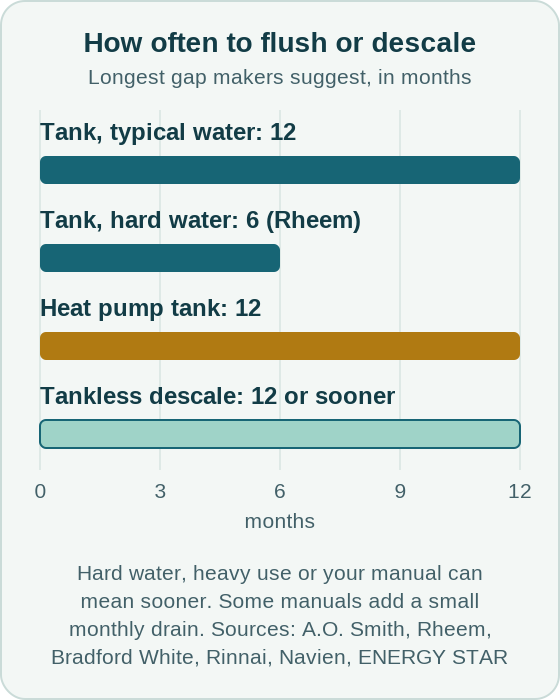
How often should you flush a water heater? For a tank heater, the makers we checked say at least once a year, and more often if your water is hard. Tankless heaters don’t have a tank to flush; they need descaling, also at least yearly. The exact interval depends on your model, your water and how much hot water you use.
How often to flush a water heater, by type
| Heater and water | What the makers say |
|---|---|
| Tank, typical water | At least once a year (A.O. Smith, Rheem) |
| Tank, hard water | More often; Rheem says every 6 months |
| New tank | First drain and flush after 6 months (A.O. Smith electric tank manual) |
| Small monthly drain | A few quarts (Rheem hybrid manual) |
| Heat pump tank | Flush yearly; clean the air filter every 6 to 12 months (ENERGY STAR) |
| Tankless | Descale at least once a year (Rinnai, Navien) |
Basis: official manufacturer guidance from A.O. Smith’s drain and flush guide, Rheem’s flushing article and the owner’s manuals listed below, plus ENERGY STAR for heat pump models.
A.O. Smith puts it simply: “most water heaters should be flushed at least once a year,” and you should “always refer to the instructions” in your heater’s handbook. Rheem says once a year for most households, and you may need to flush more often “if there is visible sediment or if your household uses a lot of water.”
Some manuals go further. A.O. Smith’s residential electric tank guide says: “After the first six months, drain and flush the water heater and inspect the anode rod. Depending on the hardness of your water, repeat this process at least annually, or more frequently if needed.” Bradford White’s gas manual lists, among tasks for a qualified service technician, “Monthly drain off a gallon of water to remove silt and sediment.” Bradford White says water heaters are generally not self-cleaning, and its sediment-reducing design “does not replace the need to periodically drain your tank.” The US Department of Energy’s Energy Saver Guide suggests draining a quart every 3 months, and adds: “Follow the manufacturer’s directions.”
Hard water means flushing more often
Hard water carries more dissolved calcium and magnesium. When it is heated in a home water heater, solid calcium carbonate deposits can form. The US Geological Survey classes water as soft up to 60 mg/L (as calcium carbonate), moderately hard at 61 to 120, hard at 121 to 180, and very hard above that. It says your local water utility or health agency can tell you your home’s hardness.
A.O. Smith says hard water means “a higher concentration of minerals, increasing the risk of sediment accumulation.” Rheem’s interval for hard water is every 6 months. A.O. Smith’s electric tank guide says the buildup rate also depends on the temperature setting, and Rheem adds heavy household water use.
Signs your water heater needs flushing
Rheem lists these signs:
- Rumbling or popping noises from the tank
- Rusty or cloudy hot water
- Running out of hot water faster than usual
- Longer recovery times between uses
- Rising energy bills without more use
These can have other causes. A.O. Smith says strange noises “can have several causes” and a qualified plumber can find the real one. Bradford White says many “rusty water” complaints are actually sand and clay sediment. If the heater is slow to recover, see how long a water heater takes to heat up.
What happens if you never flush a water heater
Sediment collects on the tank bottom. According to A.O. Smith, it “forces your water heater to work harder and use more energy,” and over time “can damage internal components, reduce your unit’s lifespan, and drive up your monthly utility bills.” Rheem says it acts like insulation at the bottom of the tank.
There is a warranty angle too. A.O. Smith’s warranty for its Voltex heat pump models covers a tank kept “free of damaging water sediment or scale deposits,” and says it is “voided if the maintenance procedures listed in the owner’s instruction manual are not followed.” Check the terms of your own heater’s warranty.
Does flushing extend a water heater’s life?
The makers say it helps. A.O. Smith’s electric tank guide says “Draining sediment extends the life of the tank, heating elements, and drain valves.” Rheem calls flushing “one of the most effective ways to extend your water heater’s lifespan,” and ENERGY STAR lists annual flushing among the “tips to maintain a long life.”
None of these sources says how many extra years to expect, so we don’t give a number. Most tanks still wear out eventually; see how long water heaters last.
Can you flush an old water heater that was never flushed?
Be careful. Rheem says older tanks that haven’t been flushed “may have hardened sediment,” and flushing them yourself “could lead to leaks or further damage.” It suggests professional help if the drain valve won’t open or leaks, or if the unit is 8 to 12 years old or older.
A.O. Smith’s electric tank manual warns that sediment “may form large masses that can prevent the tank from draining,” a job for a qualified person. Bradford White says that if a heater is more than 10 years old, “it might make sense to purchase a new water heater rather than spend money on maintenance.”
So check the age first. Our water heater age checker reads the build date from the serial number. On an old, neglected tank, ask a licensed plumber whether a flush is worth it, and compare the replacement cost.
Tankless water heaters: descaling, not flushing
A.O. Smith says tankless heaters “don’t require flushing because they do not have a tank,” but many need descaling with a cleaning solution.
- Rinnai: flush the mineral deposits “at least once a year.” Its N Series manual says hard water “must be treated and may require a more frequent flushing schedule.” Some models show a Service Soon (SS) reminder. Rinnai warns: “Damage caused by lime build-up is not covered by the water heater’s warranty.” Its FAQ says the flush “should be completed by a professional installer.”
- Navien: “Navien recommends descaling a tankless water heater at least once a year.” More minerals, a higher set temperature and more hot water use mean descaling more often. Navien recommends hiring a professional and warns that incorrect descaling that damages the heater could void the warranty.
More on choosing between the two in tank vs tankless water heater.
Heat pump water heaters
A heat pump water heater still has a tank. ENERGY STAR’s buying guide lists “annual flushing and checking the anode rod—no different than a standard electric tank.” Bradford White’s hybrid manual says “it is recommended to drain and flush the water heater tank once a year.” Rheem’s hybrid manual suggests draining “a few quarts” every month.
They also need care a standard tank doesn’t. ENERGY STAR’s 2024 guide says air filters “must be cleaned every 6 to 12 months” and condensate lines every year. It points owners to the maker’s manual for the steps.
What a flush involves, and who should do it
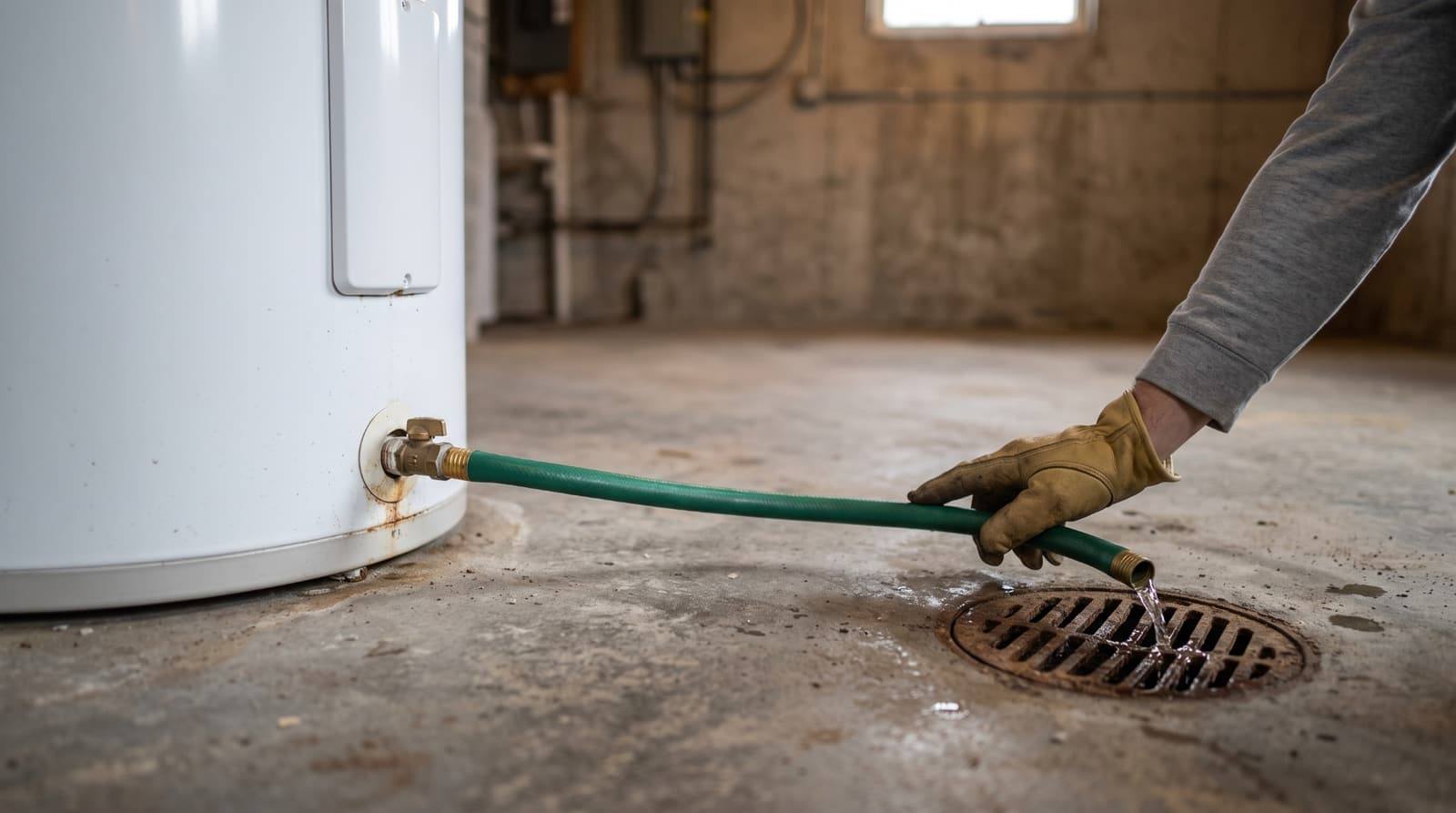
In outline, the manuals describe the same job: the heat source is turned off as the manual directs, the water is allowed to cool, a hose carries water from the drain valve at the bottom of the tank to a drain, and cold water runs through until it comes out clear. The tank must be completely full again before the heat goes back on; Bradford White’s hybrid manual warns that electric elements “will become damaged if operated without water.”
The manuals warn of scalding and, on electric models, electric shock. Bradford White’s hybrid manual says: “Shut OFF power to the water heater before draining water to avoid electrocution.” A.O. Smith says letting the heater cool first “reduces the risk of scalds,” and recommends thick gloves and safety goggles. The drain valve can also clog with sediment.
We don’t give step-by-step instructions, because the gas and electrical shut-off steps differ by model. Follow your model’s manual, or hire a licensed plumber. A.O. Smith says most tanks take 20 to 40 minutes to drain completely, longer with heavy sediment.
What a plumber charges to flush a water heater
| Service | Typical US price |
|---|---|
| Tank flush (Angi) | $110 to $200 (Angi’s overall average about $160) |
| Tank flush (HomeGuide) | $75 to $250 |
| Tankless flush (Angi) | $150 to $250 |
| Tankless flush (HomeGuide) | $150 to $350 |
Basis: trade estimates from Angi (updated July 2026) and HomeGuide (tank, August 2025; tankless, May 2024), as of October 2026. Local prices differ. Rheem and Bradford White say a pro visit often includes other checks, such as checking the relief valve. Our inspection guide covers what a service visit includes.
What to do next
- Find your model’s manual; the model number is on the rating plate.
- Check your water hardness with your water utility.
- Check the heater’s age before paying for maintenance on an old tank.
- For gas or electrical work, or a tank that won’t drain, call a licensed plumber.
Checked against the sources below on 14 October 2026. Intervals are manufacturer guidance for US household heaters, not a schedule for one heater. We have not tested any heater.